A Message Framed as a Security Reality
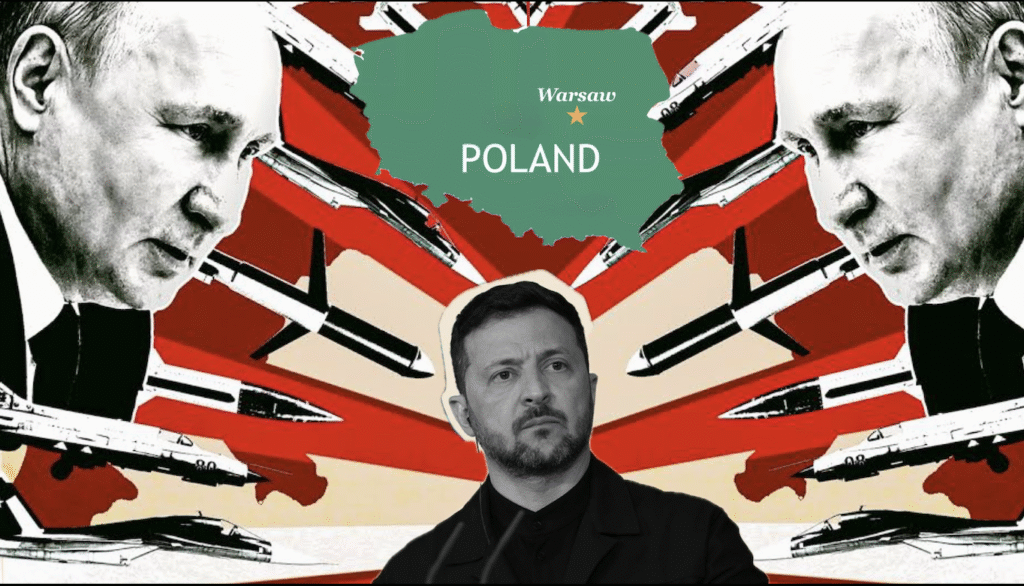
Ukrainian President Volodymyr Zelenskyy’s warning in Warsaw that Russia could target Poland if Ukraine is defeated was not an exercise in alarmism. It was a reminder delivered deliberately and publicly that the war in Ukraine has never been only about Ukraine.
Speaking alongside Polish President Karol Nawrocki, Zelensky framed Ukraine’s survival as inseparable from Poland’s security. “Without Ukraine’s independence, Moscow will inevitably turn its attention to Poland,” he said, urging both countries to “endure” by standing together. The message was blunt: Ukraine is not a buffer by accident; it is one by geography, history, and force of arms.
Why Warsaw, and Why Now
Zelensky’s choice of venue mattered. Poland has been one of Kyiv’s most committed allies since Russia’s full-scale invasion, providing military aid, logistical support, and political backing. Prime Minister Donald Tusk has positioned Warsaw as one of Ukraine’s strongest advocates in Europe.
But Polish politics is in flux. Presidential elections returned Karol Nawrocki to office with backing from the nationalist Law and Justice party, which could regain power fully by 2027. Zelensky’s visit was aimed at future-proofing the relationship ensuring that Polish support for Ukraine does not become collateral damage of domestic political change.
The Incremental Logic of Russian Strategy
This political context explains the urgency of Zelensky’s remarks. His warning was not meant only for Poland, but for a broader European audience tempted to see Ukraine as a contained conflict.
From Kyiv’s perspective, Russia advances by testing limits, consolidating gains, and probing for weakness. A defeated Ukraine would send a dangerous signal that territorial conquest through force is sustainable and that NATO’s eastern flank can be pressured.
Ukraine as a Security Contributor, Not Just a Recipient
Zelensky reinforced this point by offering Ukraine’s battlefield experience to Poland. He said Kyiv could advise Warsaw on defending against drones and strengthening security in the Baltic Sea region.
The subtext was clear: Ukraine is no longer only asking for protection. It is positioning itself as a frontline state whose lessons are directly applicable to NATO members facing similar threats.
Reconstruction as a Strategic Bond
Zelensky also invited Polish businesses to take part in Ukraine’s reconstruction, tying economic cooperation to long-term security interests. Reconstruction, in this framing, is not a postwar afterthought but part of a broader strategy to anchor Ukraine firmly within the European economic and political space.
He also invited Nawrocki to visit Kyiv, underlining the need to keep bilateral ties insulated from political uncertainty.
A Warning Europe Cannot Afford to Ignore
At its core, Zelensky’s message challenged European complacency. If Ukraine falls, the war does not end it moves.
For Poland, with its history of Russian domination and its position on NATO’s eastern edge, the warning carries particular weight. Zelensky’s task in Warsaw was not to dramatize the conflict, but to make its stakes unmistakably clear.
Stopping Russia in Ukraine, he argued, is not escalation. It is containment and Poland, in his view, has as much at stake as Kyiv. Beyond Poland, the message extends to all of Europe: the continent’s security architecture depends on the resilience of Ukraine.
Failure to support Kyiv decisively risks emboldening Moscow to test other borders, destabilize neighboring states, and undermine NATO’s credibility. Zelensky’s warning is a reminder that the fight in Ukraine is not isolated; it is a frontline struggle for the future of European stability, order, and deterrence. Ignoring it could have consequences that reach far beyond Kyiv’s borders.