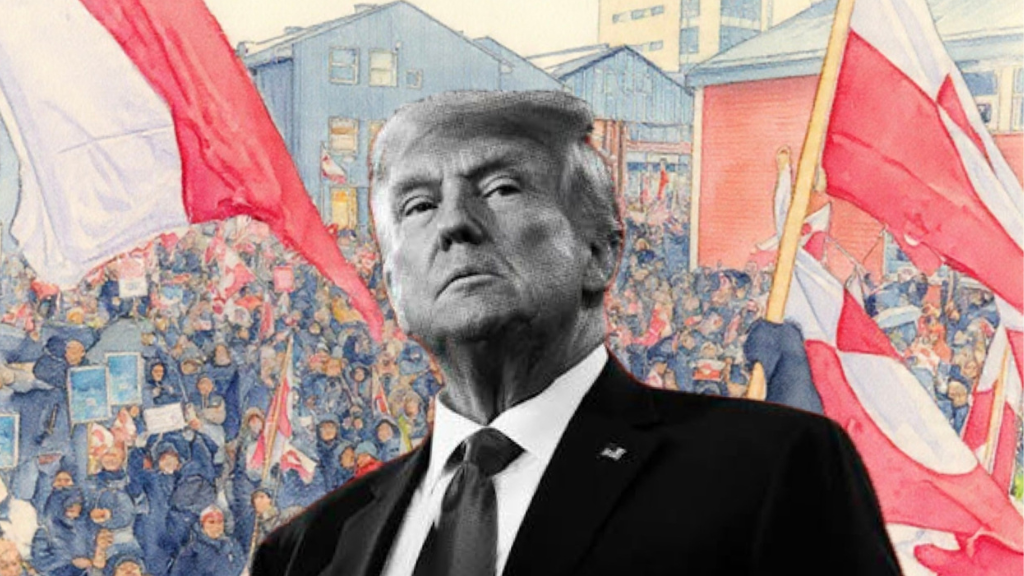
What started as political posturing over Greenland is quickly sliding into a serious trade confrontation between the United States and Europe, one that could spiral into economic damage on both sides before cooler heads prevail.
President Donald Trump’s latest move marks a sharp escalation. Over the weekend, he announced new tariffs targeting imports from eight European countries, including major economies such as Germany, France, and the United Kingdom, as well as Nordic states closely tied to Greenland. The plan is straightforward but blunt: a 10 percent tariff beginning February 1, rising to 25 percent by June if no deal is reached.
The reaction in Europe was swift. Emergency consultations followed almost immediately, and the tone hardened just as quickly. Brussels began openly discussing the possible use of its most aggressive trade defense mechanism, an instrument designed to counter economic coercion by foreign powers. Informally dubbed the “trade bazooka,” it allows the European Union to restrict market access, suspend licenses, or impose export controls in response to pressure tactics.
That such a tool is now being considered against the United States is extraordinary. It was conceived with strategic rivals in mind, not transatlantic partners. Its potential use underscores how seriously Europe is taking Washington’s threat.
At the same time, the EU is revisiting a long-delayed package of retaliatory tariffs worth €93 billion, measures that were frozen last year when both sides reached a fragile trade truce. That truce now looks increasingly unstable.
For businesses, the immediate consequence is uncertainty. Investment decisions, hiring plans, and export strategies all depend on predictability, something that has been in short supply amid repeated tariff threats that appear, disappear, and reappear with little warning. In recent months, companies on both sides of the Atlantic have grown more cautious, delaying commitments while waiting for clarity that never quite arrives.
Europe’s economy is particularly vulnerable to such shocks. Even a modest increase in tariffs can weigh on growth, especially at a time when industrial output is already under pressure. And while Europe remains economically and strategically tied to the United States, that dependence is no longer one-sided.
Mutual Damage, Limited Gain
Europe does have leverage, but using it would not be easy or fast. Any serious countermeasures would take time to design, approve, and implement, prolonging uncertainty rather than resolving it. More importantly, they would further strain relations that have already been tested by years of trade disputes and policy reversals.
The latest tariff threat also casts doubt on trade arrangements negotiated just months ago. Those agreements were meant to prevent escalation and restore stability. Now, their future is uncertain, with political support in Europe visibly eroding.
The broader concern goes beyond tariffs themselves. Repeated threats, reversals, and last-minute decisions chip away at confidence in long-term commitments. Once that trust is lost, it is difficult to rebuild, even if policies change later.
The economic stakes are significant. Trade between the United States and Europe runs into hundreds of billions of dollars annually, spanning automobiles, machinery, pharmaceuticals, energy, and services. A prolonged dispute would ripple through supply chains, raise costs for consumers, and slow growth across multiple sectors.
There is also a practical complication: the tariffs target individual countries rather than the European Union as a whole. Because the EU operates as a single market with no internal borders, goods can often be rerouted through other member states, blunting the impact of country-specific measures. That makes enforcement difficult and reduces the effectiveness of the tariffs while increasing administrative friction.
A Strategic Cost Beyond Trade
In the short term, a 10 percent tariff is unlikely to cause a dramatic economic shock. The deeper risk lies in what happens over time. Persistent unpredictability encourages trading partners to look elsewhere, to diversify markets, deepen ties with alternative partners, and reduce exposure to the United States.
That shift is already underway. Major economies are strengthening trade relationships beyond Washington, finalizing long-delayed agreements and exploring new partnerships. Once these ties solidify, they are not easily reversed.
There is a deeper irony to the Greenland standoff. In pressing aggressively on a strategic issue, Washington may be pushing its closest allies away, weakening its own economic position while creating space for competitors to expand their influence.
The real cost of tariff brinkmanship is often invisible. It shows up in factories that are never built, investments that are quietly shelved, and jobs that never materialize because companies cannot plan around policies that change overnight.
In the end, the danger is not just higher prices or slower growth. It is the gradual erosion of trust and with it, the foundations of a trading relationship that has underpinned the transatlantic economy for decades.