
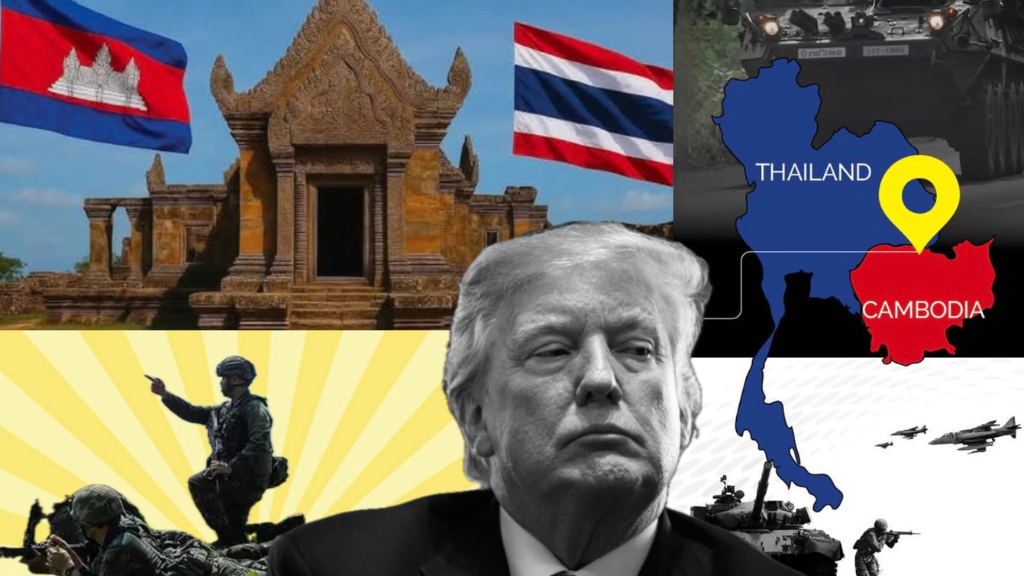
The recent flare-up of violence between Thailand and Cambodia has revived an old border dispute that never fully disappeared, despite sporadic truces and diplomatic pledges over the past decade. As both militaries exchanged fire around contested zones, Washington found itself unexpectedly pulled into the conversation, not through any official channel, but through Donald Trump’s characteristic declaration that he could stop the fighting with a single phone call.
A Conflict With Long Roots
The two Southeast Asian neighbours have a history of tension shaped by competing territorial claims, especially around the ancient Preah Vihear temple and the surrounding borderlands. While the International Court of Justice issued rulings on the boundary years ago, the settlements never erased the political sensitivities on both sides. Periodic skirmishes, often triggered by local commanders or nationalist rhetoric, have continued to erupt.
The latest confrontation reflects this long-running pattern. Both Bangkok and Phnom Penh blamed each other for provoking the exchange, and the immediate attempts at de-escalation have been cautious at best. Neither side wants a prolonged conflict, but both remain wary of appearing weak.
Trump Enters the Picture — Again
Into this tense regional dynamic came Trump’s remark: that he would “make a call” and bring the clashes to a halt. The comment fits neatly into his broader pattern of personalised diplomacy, the belief that conflicts hinge less on policy structures and more on his own rapport with leaders.
He used similar language while dealing with North Korea’s Kim Jong-un, promising that a mixture of pressure and personal charm could replace painstaking negotiations. He floated comparable ideas during the Russia–Ukraine war, hinting that peace depended on his presence rather than on the entrenched realities on the ground.
For Thailand and Cambodia, his statement is more spectacle than strategy. Neither government has indicated it is waiting for American mediation, and ASEAN traditionally prefers internal, region-driven diplomacy. Nonetheless, the claim attracted attention because it underscores Trump’s enduring view that international conflicts can be solved through direct intervention and that he alone is capable of delivering it.
Regional Sensitivities and Global Optics
Southeast Asian conflicts rarely benefit from heavy external involvement. ASEAN has long valued the principle of “non-interference,” and even during previous Thailand–Cambodia clashes, regional diplomacy moved slowly but steadily, without major superpower pressure. Trump’s comment, while unlikely to shape policy, does highlight how easily global politics intersects with local conflicts especially when the U.S. president inserts himself into the storyline.
For Western observers, it raises another question: does Trump’s approach trivialise the complexity of these disputes, or does it reflect a belief that big personalities can override bureaucratic inertia? His supporters see confidence; his critics see oversimplification.
The Bigger Picture
The Thailand–Cambodia standoff will almost certainly be resolved the way previous episodes were: through quiet talks, military backchannels, and ASEAN diplomacy rather than any sudden grand gesture. Yet Trump’s interjection reveals how his style still shapes global narratives. Even conflicts far from Washington’s immediate reach can become stages for his brand of politics.
What remains far less certain is whether such personalised diplomacy offers any durable solution. The border tensions between Bangkok and Phnom Penh rest on historical claims, local politics, and national identity issues that no quick phone call can make disappear.