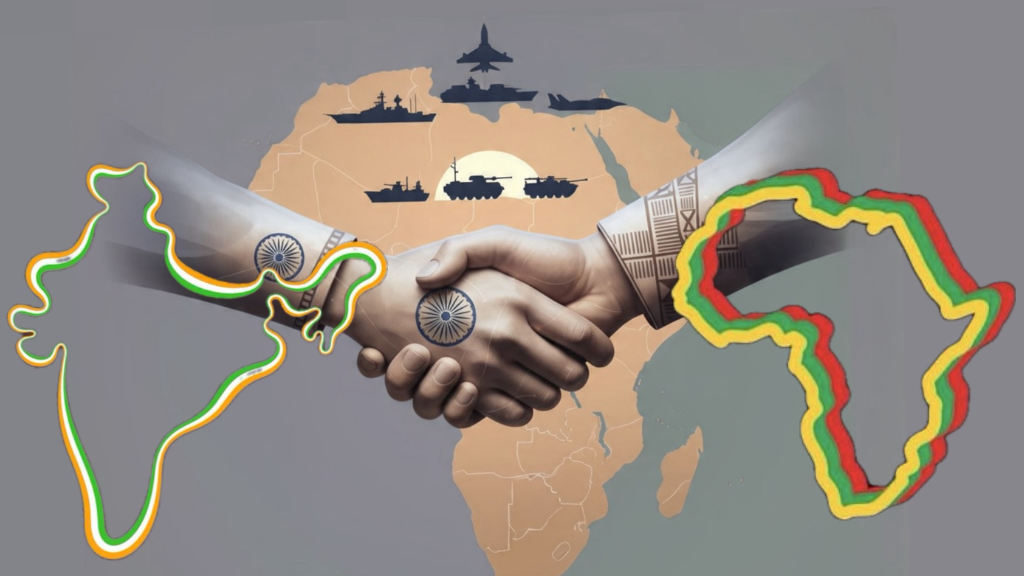
This piece reflects on my experiences on familiarization visit to India’s defence establishments, held between February 16 and March 3, 2026. This visit brought together defence journalists from 28 countries. This visit provided a rare opportunity to closely observe India’ defence establishment and her strategic outlook in a rapidly changing world. This reflective piece offers key lessons learnt around research, innovation, partnerships and cooperation applicable to Africa and Kenya in particular.
One of the key lessons learnt was the value of research and innovation in supporting India’s defence outlook. Through visits to defence related institutions in India such as Bharat Electronics based in Bengaluru, the centrality of research and innovation became more lucid as a key lesson that African countries including Kenya can learn for their security and related defence requirements. The impetus of research, innovation and development (RDI) initiatives in defence products solutions was underscored on the overall as a key contributor to national security. Some of the key catalysts for this innovation related to key government investments through grants such as those provided by the Indian government under the Innovation for Defence Excellence Program (IDEX). IDEX initiatives visited provided practical examples of their as enabling potentials to scale their innovations. These innovations have become instrumental in providing a variety of solutions both for public good and also for commercial ventures.
Visits to defence related startups such as New Space and Astrome Technologies based in ‘Bengaluru’ ‘the Silicon Valley’ of India demonstrated the value of investing in startups that respectively have supported such innovative ideas as drones and satellite communication solutions that can be applied in development and security contexts. In particular, technology was deemed to be a key plank of innovation, with academic collaboration with esteemed institutions such as the Indian Institute of Science, and startups providing the pipeline of next level of human capital and innovative problem-solving outcomes. Linked to technology was the deliberate interface with academic institutions to offer incubations and startups spaces. As a defence official interviewed in the course of the trip opined, “technological innovation is key aspect of modern warfare… as such we have the research development unit within the army that engages with the academia as part of this quest…scalable ideas are translated to the defence establishment….”. This innovation landscape has also involved working closely with foreign entities and or collaborations for joint ventures, standardization and commercialization of scaled innovations.
Two are lessons around self-reliance and indigenization of their defence requirements. This was demonstrated throughout visits to key defence installations of the Indian Army, the Navy and the Airforce. These ranged from key defence requirements of their military establishment from battle tanks, to air and naval assets while underscoring fit for purpose adaptation with foreign partners. This was particularly pitched in the context of increasingly self-help world that has been marked by weakening of a multi-lateral world and where safeguarding of sovereignty is of utmost importance. The larger implication of this and which was evident in the course of my visit was the growing mantra of ‘indigenization and self- reliance’. In stressing ‘self- reliance’, this approach is crucial to India’s pursuit of total reliance on a complete indigenization of its security needs by the year 2047 under the ‘Aatmanirbhar Bharat’ mantra. This mantra if scaled by countries in Africa and beyond is laden with several potentials. One is that enhances a country’s sovereignty and in particular technological sovereignty, secondly is that it spurs economic opportunities, critical to national economies, and thirdly is that it allows the scaling of such innovations to address a variety of societal needs such as reinvigorating a manufacturing hub to meet a variety of commercial and security needs.
Three, is the value of maritime cooperation. This was in particular picked as key lesson given the centrality of oceans in global trade. This was a key lesson learnt from observing the International Fleet Review held in the Visakhapatnam Coast in mid-February 2026. This event drew the participation of 74 countries, with some of the invited countries showcasing their naval assets. This exercise demonstrated synergies that cooperation at sea is not only critical for global trade, but also helps to promoting joint cooperation and coordination in addressing maritime security threats in the Western Indian Ocean region. The international fleet review demonstrated thus that threats ranging from piracy, narcotics trafficking and illegal migration can be easily be addressed when states cooperate in the maritime domain. The International Fleet Review, also provided an opportunity for India to showcase the outputs of its indigenization program in shipbuilding with a spectacular display of her indigenous aircraft carrier INS Vishkrant, a key attraction during the fleet review.
Fourth, is the value of private sector and government collaborations in key spheres such as the uptake of technological innovations to address statist and human security threats. The significant lesson here from this visit was the recognition and appreciation that rapid societal transformation is hinged on the input of technology given the changing nature of our world. Working closely with the private sector therefore has the potential to incubate ideas, scale them including in the update of innovations enabled by generative artificial intelligence (AI) and quantum computing. A key take home here is that startups can be boosted with government grants. This was evident in this realm with the key testimonials of grantees under the Innovation for Defence Excellence (IDEX), a funding initiative of the Indian government. IDEX has provided a nurturing eco-system to support innovation and entrepreneurship in the defence sector. Visits to defence startups based in Bengaluru such as Astrome Technologies which has curved a niche for itself in wireless and satellite communications as well as the SSF Defence that has created a niche in indigenous small arms manufacturing illustrated this growing potential.
A fifth lesson learn the visit and which would be applicable for a majority of African countries in the security outlook is the embrace of a whole of nation approach to security. From an Indian perspective, this has entailed joint training and enhanced collaborations across the Navy, Airforce and the Army alongside a host of other domestic security agencies. This approach it was evident enables operational efficiency and jointness in security responses to a variety of statist, including human security threats. This cooperation was evident in Rajasthan with seamless display of India’s airpower capabilities during the Vayu Shakti event held in Jaisalmer on 27th February 2026. Held by the Indian Air Force, and graced by the Honorable President of India Draupadi Murmu, provided an opportunity to also showcase India’s indigenous capabilities in light aircrafts production and surface to air missile systems. This was a clear demonstration of the synergies needed to launch defence operations in a coordinated manner while embracing technology.
In conclusion, the familiarization visits to India’s defence establishment provided multiple scalable lessons around defence and security preparedness in the 21st century. Key transferable lessons for African countries including Kenya including reinvigorating the research and innovation space to support the defence and security ecosystem, governments-private sector collaboration, a whole of government approach to security, while leveraging on technologies to support the ever-changing security landscape.
John Mwangi Githigaro is an independent scholar based in Nairobi, Kenya. He has previously been a Senior Research Fellow for Security and Defence at the Global Centre for Policy and Strategy Kenya. Before that he had taught previously at St. Paul’s University, Kenya and at the United States International University, Nairobi (USIU-A). He has a Ph.D. in International Relations at the United States International University (USIU), Nairobi, Kenya with a focus on peace and security studies. John has 15 years of professional experience in academic research, higher education teaching, and public policy analysis and project management. John continues to maintain an active research profile in international relations to date in the sub-field of peace and security studies. His research interests include, regional integration, counter-terrorism, policing, refugeeism, land and identity conflicts in the Horn of Africa, and the Sahel Region with a number of publication outputs. Some of his outputs have been published in the Critical Studies on Terrorism, the Journal of Third World Studies, African Conflict and Peacebuilding Review, Africa Insight, African Peace and Conflict Journal, and the Journal for Deradicalization.