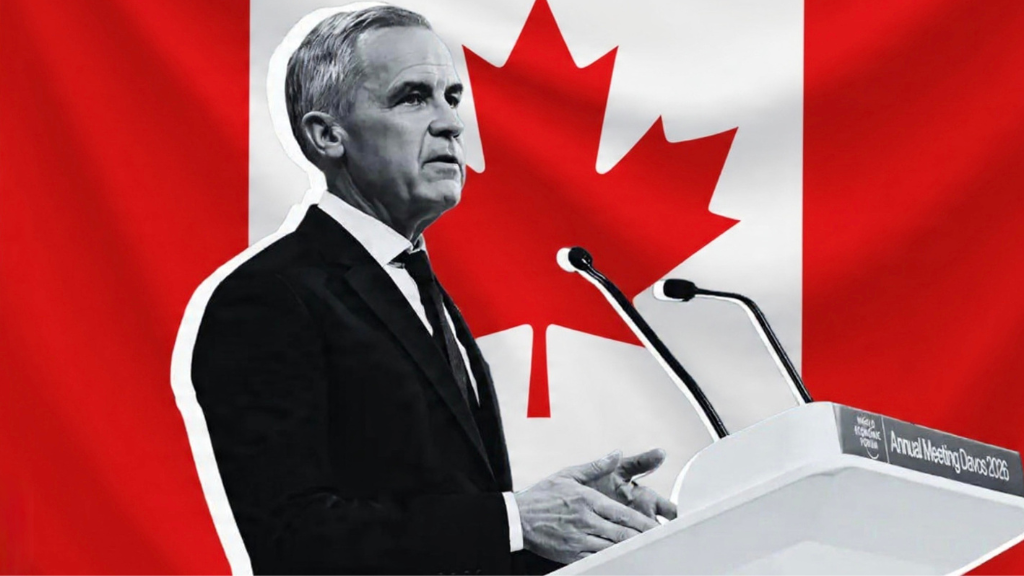
Until recently, Mark Carney was best known outside Canada as a steady technocrat: a former central banker who ran both the Bank of Canada and the Bank of England, fluent in the language of markets, stability, and risk. This week in Davos, however, Carney stepped into a very different role and emerged as one of the most talked-about political figures on the global stage.
Ironically, two forces helped propel him there: Donald Trump and the World Economic Forum.
While most world leaders have learned to tiptoe around Trump, flattering him when necessary and avoiding direct confrontation, Carney chose another path. At Davos, he did not shout, insult, or posture. Instead, he challenged the assumptions underpinning the Trump worldview, calmly and in full view of a global audience.
The result was a speech that resonated far beyond the conference hall.
A speech that cut against the grain
Carney’s Davos address was framed as a diagnosis of the global moment rather than a direct attack on any one country. He spoke of a world sliding away from rules and norms toward raw power politics, where strength increasingly substitutes for legitimacy.
“The rules-based order is fading,” he warned, describing an environment in which powerful states act with impunity while weaker ones absorb the consequences. Compliance, he argued, no longer guarantees security. Nor, he added pointedly, is nostalgia for the old order a viable strategy.
The line that drew the biggest reaction was also the simplest: “If we’re not at the table, we’re on the menu.”
Though the speech never mentioned Trump or the United States by name, few in the room missed the subtext. Delegates responded with a standing ovation, an unusual reception for a sitting leader delivering a sober geopolitical critique.
Carney reportedly wrote much of the 30-minute address himself. At its core was a defense of Canadian sovereignty and the idea that middle powers still matter, even in an era dominated by great-power rivalry.
Tariffs, Greenland, and the rupture moment
Carney also addressed the growing use of economic pressure as a political weapon, pointing to tariffs and trade threats as tools of coercion rather than cooperation. He criticised attempts to strong-arm allies over Greenland, stressing that Canada opposed punitive tariffs and favoured dialogue to protect shared Arctic interests.
This, he argued, was not a moment of gradual change but of rupture.
Economic integration, once sold as a stabilising force, is now routinely weaponised. Yet Carney rejected the idea that this trajectory is inevitable. History, he said, does not have to bend toward authoritarianism and exclusion; it can still move toward fairness and justice, if countries choose to act.
For Canada, that meant embracing its role as a middle power willing to build alliances, defend sovereignty, and model pluralism at a time when ethnic nationalism is on the rise.
In one of the speech’s most personal passages, Carney described Canada not as an abstract ideal but as a lived experience, a society where people are not defined by birth, wealth, colour, or creed. “It’s the greatest country in the world to be a regular person,” he said, drawing applause from the hall.
A wider world, not fewer options
Carney also defended Canada’s efforts to diversify its global relationships, including a recent agreement with China. Acknowledging the risks, he emphasised that clear “guard rails” were essential but so was engagement.
Within those boundaries, he argued, there were real opportunities in energy, agriculture, and financial services. Cutting ties entirely would not make Canada safer or stronger; building a broad web of connections would.
Trump hits back and Carney doesn’t blink
Trump, speaking later in Davos, did not let the speech pass quietly. He accused Canada of benefiting unfairly from the United States and suggested that Carney’s remarks showed a lack of gratitude. He also revived claims about Canada’s interest in his proposed “Golden Dome” missile defence system and again floated the idea of annexation, sharing an AI-generated image showing Canada and Greenland absorbed into the US.
Carney’s response was measured but firm.
Canada, he said, thrives not because of American generosity but because of Canadian values. While acknowledging the depth of the bilateral partnership, economically, culturally, and in security he rejected the notion of dependency.
“We are masters in our home,” Carney said. “This is our country. This is our future.”
Trump escalated further, publicly disinviting Carney from a newly announced “Peace Board” focused on Gaza. In the same appearance, Trump reiterated that the United States would use overwhelming force to secure Greenland if necessary, warning that refusals would be “remembered”.
Why the speech landed at home and abroad
The reaction in Canada was swift and largely supportive.
Political analysts noted that Carney tapped into a growing desire among Canadians to see their leaders assert independence without theatrics. Jack Cunningham, a professor of international relations at the University of Toronto, argued that Carney succeeded where others had hesitated.
“For years, leaders treated Trump like a volatile relative who needed constant management,” Cunningham said. “Carney confronted him directly and Canadians noticed.”
Others saw the speech as a turning point. Bob Rae, Canada’s former ambassador to the UN, framed the moment as one in which superpowers are increasingly willing to bypass international rules altogether. Carney’s message, he argued, was not to abandon global institutions but to recognise how fragile they have become and act accordingly.
Laura Stephenson of the University of Western Ontario described a mix of pride and unease among Canadians. Carney’s bluntness, she said, showed political courage, even if it carried risks.
The praise crossed party lines. Former Conservative minister James Moore urged Canadians to set aside partisan instincts and listen carefully to the speech. Conservative MP Michelle Rempel Garner echoed that sentiment, writing that Carney had accurately named the realities of a fractured global system and now needed to back words with action.
From technocrat to standard-bearer
Carney did not arrive in Davos intending to become a symbol. Yet by refusing to soften his message and by articulating a clear alternative to transactional power politics, he found himself cast in that role.
In a world searching for direction, Canada’s banker-turned-prime minister offered something rare: clarity without bluster. And for the moment, at least, the world is listening.