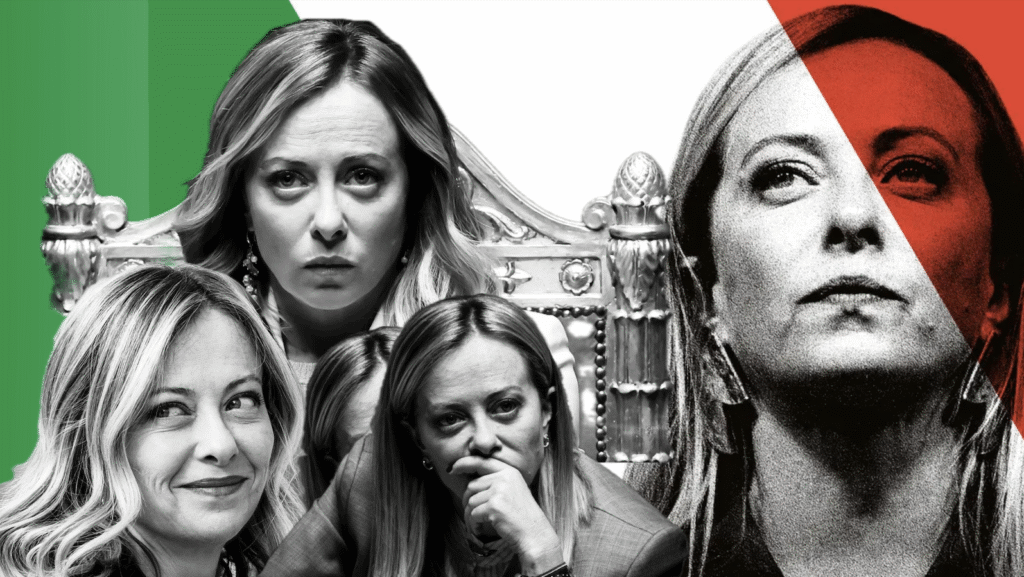
Political leadership in Europe has become unusually fragile. Even leaders who appear secure often govern atop shaky coalitions, weakened institutions, or shrinking mandates. In this landscape, Giorgia Meloni stands out. With a solid parliamentary majority at home and growing credibility abroad, Italy’s prime minister has become one of the few European leaders who project durability rather than drift.
This outcome was far from inevitable. When Meloni won the 2022 election, much of the international press focused on her political origins, warning of a post-fascist figure entering government in a country long associated with instability. Many assumed she would struggle to match the international stature of her predecessor, Mario Draghi, whose technocratic authority and reputation in financial circles made him unusually popular abroad. Instead, Meloni has done something Draghi never fully managed: she has combined external credibility with internal cohesion.
From Chronic Instability to Unusual Longevity
Italy is not known for durable governments. Since 1948, the average lifespan of an Italian cabinet has been just sixteen months. Against that backdrop, Meloni’s government is already the third longest-serving in the history of the Italian republic. If it lasts until the scheduled end of the parliamentary term in 2027, it would become the first post-war Italian government to complete a full mandate without collapsing, re-forming, or returning to parliament for renewed confidence.
The contrast with Draghi is instructive. Draghi governed through an all-encompassing coalition that brought together left and right, producing constant bargaining and limited political ownership. Meloni, by contrast, leads a coherent right-wing alliance resembling the coalitions first assembled by Silvio Berlusconi in the 1990s. The ideological distance within her government is narrower, and crucially, she dominates it.
This dominance reflects both institutional evolution and personal skill. Italy’s constitution, shaped by the trauma of fascism, deliberately weakened the executive. Repeated attempts to strengthen the prime minister’s role have failed for decades, blocked by veto coalitions and partisan maneuvering. Meloni has revived this debate by proposing the direct election of the prime minister, reframing an old ambition in language that resonates with voters accustomed to leader-centered politics.
Whether such a reform will pass remains uncertain. Constitutional change requires either overwhelming parliamentary support or a referendum that, while free of turnout thresholds, tends to favor mobilized opposition. Yet even without formal reform, Meloni already embodies the shift: Italy now behaves as if it has a strong prime minister.
Leader-Centered Politics Comes of Age
Italian politics has been leader-driven since 1994, when Berlusconi reshaped the electoral landscape and collapsed the old proportional system that had sustained the “First Republic.” Since then, Italians have increasingly voted for coalitions defined by their leaders, even when constitutional reality lagged behind electoral expectations.
Meloni is a product of this evolution. She was the only major leader to remain outside Draghi’s pandemic-era government, allowing her to campaign in 2022 as both an insider with experience and an outsider untouched by compromise. That positioning proved decisive. Her party, Fratelli d’Italia, long a junior partner within the right, emerged as the largest force in parliament, overtaking Matteo Salvini’s League.
Initially, Meloni benefited from a more uncompromising anti-establishment tone. Over time, however, her success has rested on moderation rather than provocation. Critics now argue she governs more like a traditional Christian Democrat than the populist firebrand of her early image. That assessment is not entirely wrong and it helps explain her endurance.
Foreign Policy as the Axis of Power
Meloni’s government is not an activist reform machine. Of her three flagship reforms justice, regional autonomy, and direct election of the prime minister only the justice reform has moved meaningfully forward. Instead, Meloni has concentrated her political capital on foreign policy, where she understands credibility translates into domestic authority.
This strategy has paid off. Meloni has positioned herself comfortably within European and transatlantic networks, cultivating strong ties with both U.S. President Joe Biden and former President Donald Trump. While Salvini attempted to style himself as Italy’s Trumpian figure, it is Meloni who has become Italy’s undisputed representative in Washington and Brussels.
Her European role is shaped less by grand ideological projects than by reliability. At a time when institutions such as the French presidency appear weakened and newer leaders lack gravitas, Meloni offers predictability. She speaks the language of fiscal responsibility, NATO alignment, and institutional continuity qualities that matter more in Brussels than rhetorical ambition.
Fiscal Discipline as Political Capital
Perhaps the most underappreciated pillar of Meloni’s stability is fiscal prudence. Under Finance Minister Giancarlo Giorgetti, Italy has resisted the temptation of expansionary populism. Budget deficits have been lower than promised, spending commitments restrained, and markets reassured. In a high-debt country like Italy, this discipline is not ideological it is existential.
This approach has defused one of Europe’s longstanding anxieties: Italy as a financial time bomb. By removing that risk, Meloni has increased her room for maneuver abroad and reduced pressure at home. Coalition partners may grumble, but they cannot credibly challenge a leader whose economic stewardship commands respect beyond Italy’s borders.
Scenarios Ahead: Stability With Limits
The most likely outcome is continuity. Meloni enters the next election cycle as the favorite, benefiting from a fragmented opposition and a political culture inclined to personalization. The center-left Democratic Party has shifted sharply left under Elly Schlein, embracing agendas that resonate poorly in an aging society. Referendums, often the opposition’s preferred weapon, have recently failed to mobilize voters.
The greater risk to Meloni may come from institutional change. A move toward a purely proportional electoral system would weaken leader-centric politics and dilute her advantage. For now, it is unclear why she would support such a reform.
Meloni’s formula is ultimately simple but effective: disciplined public finances, a strong personal brand, and a selective reform agenda that avoids overreach. In a country long synonymous with political volatility, that combination has produced something rare and that is governability.
Her rise does not signal a transformation of Italy’s institutions. It signals something subtler and perhaps more consequential: Italy has finally found a leader capable of navigating its structural weaknesses while projecting stability at home and authority in Europe.