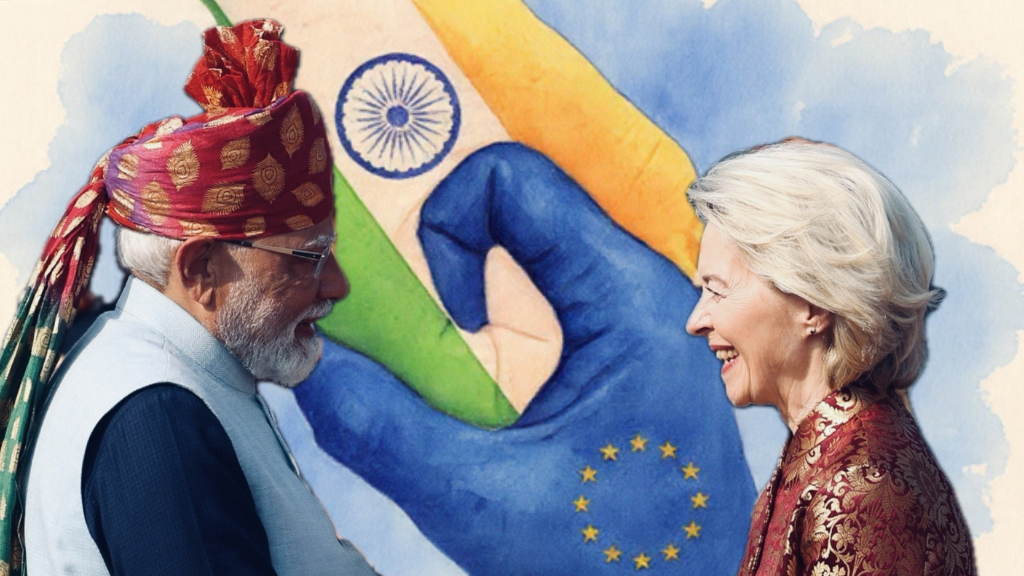
While much of the world is sliding deeper into protectionism, India and the European Union are moving in the opposite direction. In New Delhi this week, both sides are preparing to conclude what European Commission President Ursula von der Leyen has described as the “mother of all trade agreements”, a comprehensive free trade pact paired with a new security and defence partnership.
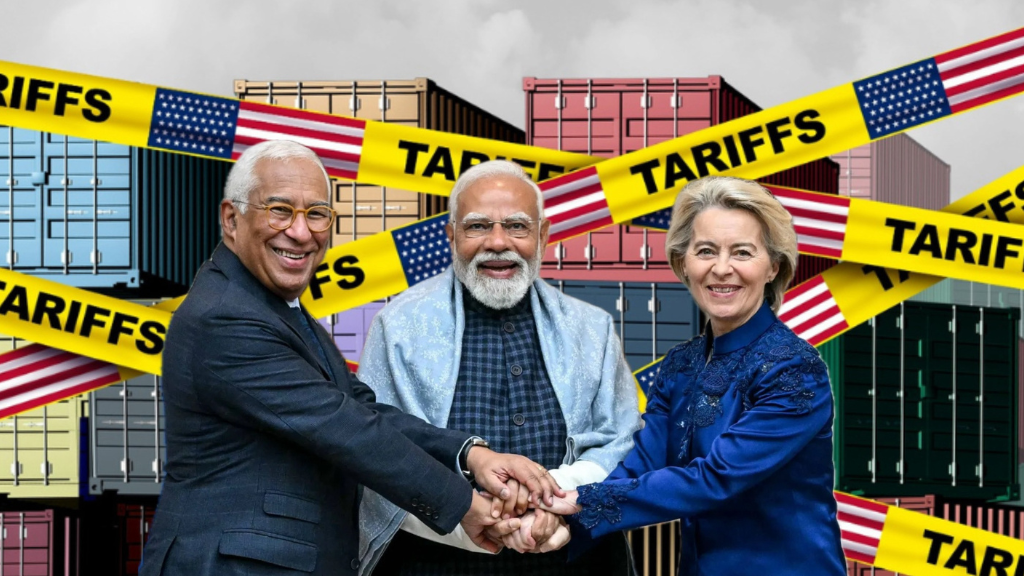
The timing is no coincidence. President Donald Trump’s renewed embrace of tariffs, including a 50 percent duty on selected Indian exports, has pushed New Delhi to accelerate efforts to diversify its commercial ties. Europe, meanwhile, is wrestling with sluggish growth, widening trade imbalances, and the strategic risk of relying too heavily on China. In that context, India has emerged as one of the bloc’s most promising long-term partners.
A Partnership Shaped by Global Shocks
Two developments have given fresh urgency to the EU–India talks: Russia’s war in Ukraine and the return of aggressive U.S. trade barriers. Washington has attempted to use tariffs to pressure India over its continued purchases of Russian energy. Brussels has taken a different route, choosing engagement over coercion by offering deeper economic and strategic cooperation.
At the centre of this week’s summit is a free trade agreement linking markets that together serve nearly two billion people and generate close to a quarter of global output. Negotiations, which span more than two dozen chapters covering goods, services and investment, have dragged on for over a decade. Officials now expect a formal announcement on January 27.
Alongside the trade accord, the EU and India are set to unveil a security and defence partnership, only the third such arrangement the bloc has signed in Asia, following similar deals with Japan and South Korea. The move is geopolitically significant given India’s long-standing military ties with Moscow.
Europe’s Objectives
From Brussels’ perspective, the agreement is about market access and strategic positioning in Asia.
European negotiators are pressing for:
- Sharp reductions in India’s import duties on cars, which currently exceed 100 percent and disadvantage European automakers competing with Chinese brands.
- Cuts to tariffs on wines and spirits, where levies can rise as high as 150 percent.
- Expanded access for agricultural products, a politically sensitive issue as farmers protest across both continents.
- Closer integration of supply chains in advanced manufacturing, electronics and clean-energy technologies.
European officials also hope the partnership will gradually draw India closer to EU strategic priorities, including a long-term shift away from reliance on Russian defence equipment.
What New Delhi Stands to Gain
For India, the deal offers both insulation from external shocks and a pathway to faster growth.
Trade in goods between the EU and India reached about $136 billion in the 2025 financial year, with Indian exports accounting for nearly $76 billion. Yet Indian products still make up only around 2.5 percent of total EU imports — a share the government wants to expand.
India’s negotiating priorities include:
- Duty-free entry for textiles and clothing, on par with concessions already extended to Bangladesh and Pakistan.
- Simpler regulatory approval for pharmaceutical exports.
- Greater mobility for Indian professionals, including skilled workers and seasonal staff.
- Joint defence manufacturing that would plug Indian firms into European weapons supply chains.
- Participation in EU research programmes such as Horizon, the bloc’s flagship innovation platform.
According to the Global Trade Research Initiative (GTRI), most tariff cuts under the agreement would lower production costs and strengthen value-chain links rather than undercut domestic industries.
Economies That Fit Together
Supporters of the pact argue that India and Europe compete far less than they complement one another.
India’s strengths lie in labour-intensive and downstream manufacturing, garments, footwear, smartphones, auto components, refined fuels and generic medicines. Europe specialises in high-end machinery, aircraft, electronics, chemicals and medical equipment.
“Because the two sides operate at different levels of the production chain, removing tariffs mainly reduces costs instead of displacing industries,” said Ajay Srivastava, founder of GTRI. Much of India’s export growth to Europe has replaced suppliers from third countries rather than European producers.
Points of Friction
Despite the optimism, several obstacles remain.
Agriculture is the most sensitive area. Nearly half of India’s workforce depends on farming, making the government reluctant to expose the sector to European competition. In the EU, farmers are already protesting separate trade agreements, increasing political pressure on Brussels.
Steel is another sticking point. The EU has recently raised tariffs on foreign steel and introduced a carbon border tax. India sees both measures as disguised protectionism rather than climate policy.
Even so, negotiators on both sides say compromise is possible. “We don’t agree on everything,” one EU official said, “but we share the same big objectives, fewer risky dependencies, more resilient supply chains, and a more predictable global order.”
A Long-Term Strategic Gamble
If finalised, the agreement could expand India’s trade surplus with Europe by more than $50 billion by the end of the decade and lift the EU’s share of Indian exports beyond 22 percent. For Brussels, it offers a route to diversify away from China and reassert influence in Asia. For New Delhi, it promises access to markets, capital and technology while preserving strategic independence.
At a time when tariffs and rival blocs are reshaping global commerce, the EU–India pact would stand out as an unusual bet on openness and a reminder that economic cooperation still has political value in a fractured world.