Mark Carney has never lacked credentials. His rise through the world of central banking was swift and impressive: first as governor of the Bank of Canada, then remarkably as head of the Bank of England from 2013 to 2020, the first non-British citizen ever to hold that job in the institution’s three-century history.
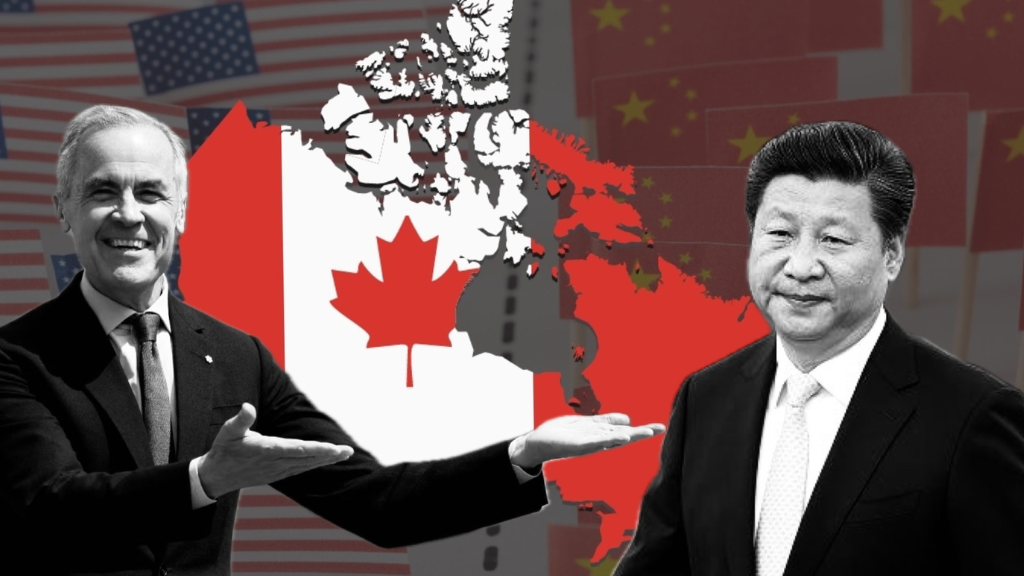
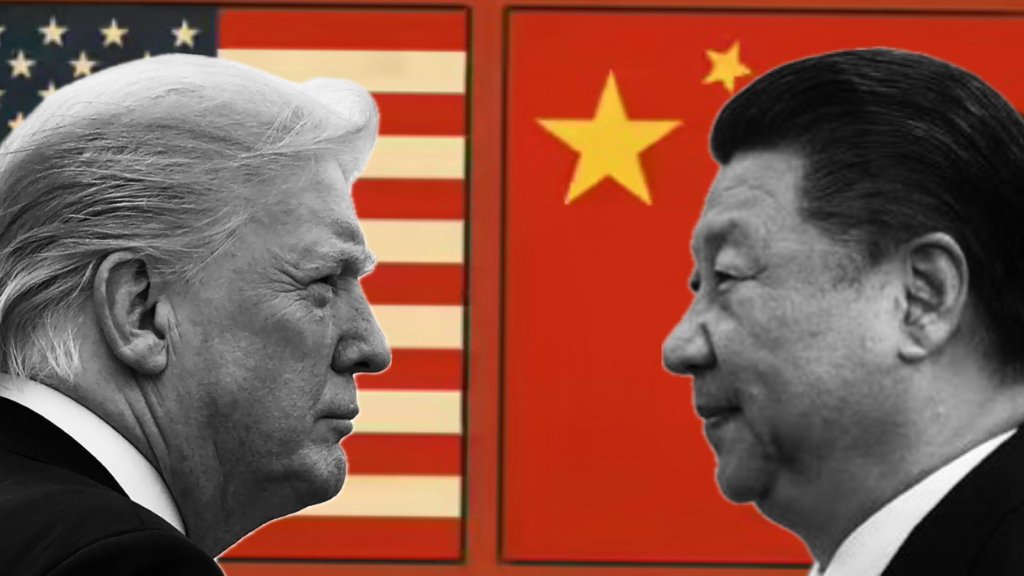
Now, as Canada’s prime minister, Carney finds himself dealing with a very different kind of problem. Instead of managing interest rates and financial crises, he is trying to steer a middle power through a sharpening rivalry between two giants: the United States and China. In that triangle, Ottawa is the smallest player and increasingly the most vulnerable.
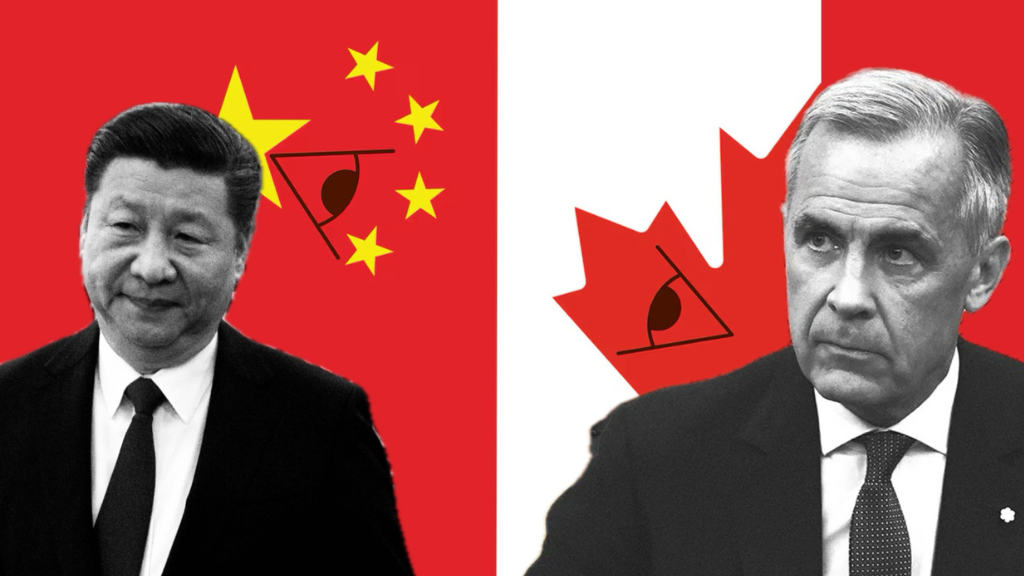
With relations with Washington strained, Carney has begun looking east. Beijing, for its part, has its own reasons to welcome a warmer relationship with Canada, especially as tensions with the United States continue to rise. When Carney arrived in China for a four-day visit that ended in a new “strategic partnership,” the United States was not part of the talks but it was clearly shaping them.
A Search for Leverage
Carney’s central worry is Canada’s dependence on the U.S. market. That dependence has become more uncomfortable since Donald Trump returned to the White House in January 2025. Since March, Washington has imposed shifting tariffs on Canadian exports, citing drug smuggling across the northern border and the need to reduce America’s trade deficit with Canada.
The uncertainty has rattled Canadian businesses and policymakers alike. For Carney, China appeared to offer a way to reduce that vulnerability or at least to signal that Canada has alternatives.
Trade concessions dominated the Beijing visit. According to the Prime Minister’s Office, the new partnership focuses on cooperation in energy, clean technology, and climate-related industries. Carney met with Chinese executives and investors to encourage fresh capital flows into Canada, particularly in renewable energy and advanced manufacturing.
The most eye-catching move, however, involved electric vehicles.
Opening the Door to Chinese EVs
Under the new arrangement, Canada will allow the import of up to 49,000 Chinese-made electric vehicles at a preferential tariff rate of 6.1 percent. Carney argued that this figure simply restores pre-dispute levels and would represent only about three percent of Canada’s annual new vehicle sales.
His government insists the policy will strengthen Canada’s manufacturing base. The official statement predicts that within three years, Chinese companies will enter joint ventures with Canadian partners, building EVs in Canada and creating new jobs while expanding the country’s supply chain.
How this will work in practice remains unclear. Will Canada end up both importing Chinese vehicles and assembling them domestically under Chinese ownership? That question has not been fully answered. What is clear is that Chinese automakers gain easier access to the Canadian market and an invitation to invest inside it.
What Canada Gets in Return
In exchange, Ottawa secured a tentative breakthrough on one of its most politically sensitive exports: canola seed. China has long used canola as a pressure point in trade disputes with Canada, and in 2025 imposed an 85 percent tariff in retaliation for Western restrictions on Chinese EVs.
Beijing has now agreed, in principle, to cut that tariff to around 15 percent.
For Canadian farmers, the stakes are enormous. China is Canada’s second-largest export destination and a market worth nearly $3 billion annually for canola producers. Industry figures describe canola as the backbone of Canadian agriculture, generating more than $40 billion in economic activity each year and supporting over 200,000 jobs.
Lower tariffs could revive a sector that has struggled under trade retaliation and provide Carney with a powerful political win in rural Canada.
A Divided Reaction at Home
Not everyone is convinced the deal is a good trade-off.
Ontario Premier Doug Ford, whose province is Canada’s main automotive hub, warned that Ottawa is inviting an influx of cheap Chinese vehicles without firm guarantees of immediate domestic investment. In a public post, he accused the federal government of putting Canada’s auto sector at risk in exchange for uncertain promises.
There is also skepticism about the broader meaning of the so-called “strategic partnership.” China categorizes its foreign relationships with careful precision, ranking countries according to their importance to Beijing’s long-term interests. Despite the headline language, Canada’s new status places it near the bottom of China’s diplomatic hierarchy, hardly the mark of a major strategic prize.
A Risky Trade-Off
Viewed bluntly, Carney appears to have sacrificed part of Canada’s auto industry protections to rescue its canola farmers. The irony is difficult to miss. During the 2025 election campaign, Carney called China Canada’s “largest geopolitical risk.” Now, his government is deepening economic ties with that same country at a moment of intensifying U.S.–China rivalry.
Whether this is clever diversification or strategic miscalculation remains to be seen. What is certain is that Canada is trying to balance between two powers whose conflict is growing sharper by the year. In doing so, Ottawa risks becoming less a partner and more a bargaining chip.
China has secured easier market access and new investment opportunities. Canada has gained relief for a key export sector. But the long-term cost to its industrial base and its geopolitical position, may only become clear later.
For a prime minister who once warned of Beijing’s dangers, the new partnership raises an uncomfortable question: has Canada reduced its risks, or simply shifted them?