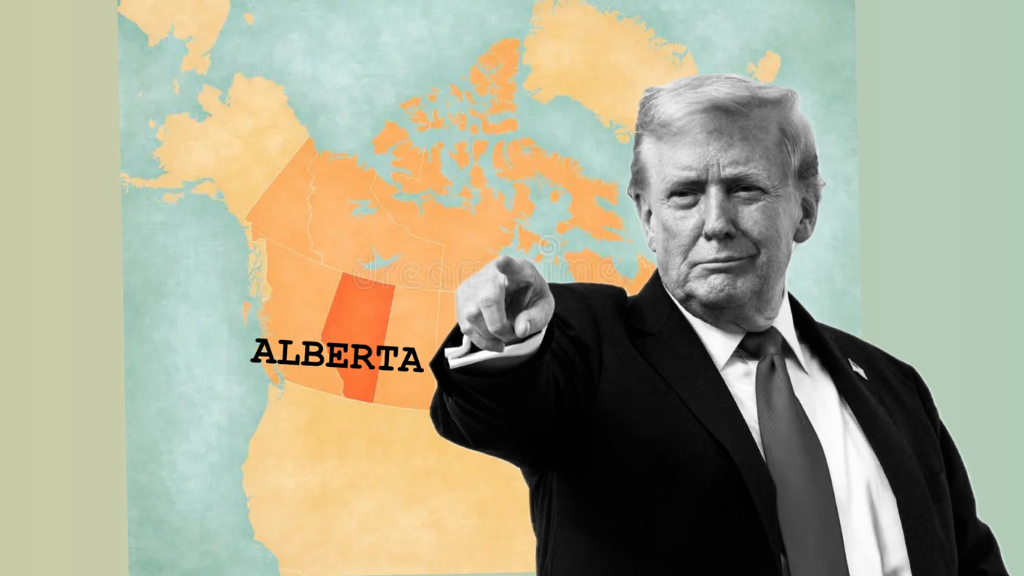
A new territorial dispute is stirring tensions between the United States and Canada and this time, it has little to do with President Donald Trump’s past musings about absorbing his northern neighbor as a 51st state.
Canada’s prime minister, Mark Carney, this week urged Trump to “respect Canada’s sovereignty” after reports revealed that U.S. State Department officials had met repeatedly with representatives of a group advocating for Alberta’s independence. According to the Financial Times, those meetings have taken place three times since April of last year.
The organization, known as the Alberta Prosperity Project, wants to force a provincial referendum on whether Alberta should break away from Canada. One of its leaders said in a post on X that the group intends to seek a $500 billion credit line from the U.S. Treasury to help fund what it calls a transition to “a free and independent Alberta.”
U.S. officials sought to downplay the matter. A White House spokesperson told CNN that American diplomats regularly meet with civil society groups and that no promises or backing were offered.
Still, the reports have caused political backlash in Canada at a sensitive moment, as Ottawa tries to rally public unity in response to Trump-era trade threats and tariffs. British Columbia’s premier described the Alberta group’s outreach to Washington as bordering on “treason.”
Here is what is known about Alberta’s independence movement and how realistic its ambitions may be.
Alberta’s Place in Canada
Alberta is a resource-rich province in western Canada, roughly comparable in size to Texas. It has a population of about five million and includes parts of the Rocky Mountains, along with world-famous destinations such as Banff and Lake Louise.
Its economy is driven largely by energy production and agriculture. Alberta’s oil sands account for roughly 84 percent of Canada’s crude oil output, earning it the nickname “the energy province.”
Politically, Alberta has long leaned conservative, even as cities like Calgary and Edmonton have become more progressive in recent years. Premier Danielle Smith has cultivated warmer relations with Trump than most Canadian leaders, including a visit to his Mar-a-Lago residence last January.
That approach has contrasted sharply with other provincial leaders, who have closed ranks against Trump’s trade policies and comments about Canada’s territorial integrity.
Why Some Albertans Want Out
Calls for separation are rooted in a sense of frustration with federal politics in Ottawa. Many in Alberta believe national climate policies harm their oil industry, that they contribute more in federal taxes than they receive in services, and that their political values are overwhelmed by larger, more liberal provinces in eastern Canada.
“Western alienation has existed since Confederation and certainly since Alberta became a province in 1905,” said Michael Solberg, a former adviser in Prime Minister Stephen Harper’s government and now a partner at New West Public Affairs.
“It tends to intensify when people feel Ottawa is making decisions that directly threaten their livelihoods,” he said.
That frustration grew during pandemic restrictions and over more than a decade of Liberal leadership. It sharpened further after Carney’s Liberals won the 2025 federal election amid a surge of nationalist sentiment tied to opposition to Trump.
Soon after that election, Alberta passed legislation making it easier to trigger a referendum on separation. Still, the movement lacks a central leader and has no representation in the provincial legislature. Solberg described it as largely driven by a small number of vocal activists whose influence is amplified online.
Trump’s Role in Reviving the Idea
Trump’s return to office has energized Alberta’s separatist circles, some of whom now see the U.S. president as a potential ally.
At a rally last summer, supporters wore red “Make Alberta Great Again” caps and praised Trump as a defender of energy-producing regions. While many attendees supported full independence, others went further, suggesting Alberta should become America’s 51st state.
Earlier this year, a billboard appeared along the Calgary–Edmonton highway urging residents to tell Premier Smith that Alberta should “Join the USA,” funded by a group calling itself “Canadians for the 51st State.”
Senior U.S. officials have also made remarks that caught attention in Canada. Treasury Secretary Scott Bessent recently called Alberta a “natural partner” for the United States, citing its energy resources and independent culture. He suggested that a referendum might be approaching and criticized Canada for blocking pipeline access to the Pacific.
“People want sovereignty. They want what the U.S. has,” Bessent said in an interview with the conservative network Real America’s Voice.
How Real Is the Threat of Secession?
Solberg believes a referendum is increasingly likely, noting that only Quebec has previously held votes on leaving Canada, the last in 1995, when separation failed by a razor-thin margin.
“All signs suggest Alberta could hold a referendum this fall,” he said. “The stakes are rising, and it’s starting to feel less hypothetical.”
One group, Stay Free Alberta, is gathering signatures to force a vote and must collect nearly 178,000 valid names by May. Some of its rallies have drawn sizable crowds.
Yet polling indicates limited public support for independence. A January survey by Pollara Strategic Insights found only 19 percent of Albertans favor secession.
Professor Lori Williams of Mount Royal University says many supporters may be acting symbolically rather than literally.
“For some, signing the petition is more about sending a warning to Ottawa than actually wanting to leave Canada,” she said. “They want leverage, not necessarily separation.”
Opponents of independence have also mobilized. A citizen-led petition against secession has already surpassed 400,000 signatures.
Indigenous communities have emerged as some of the strongest critics of the movement, pointing out that their treaties with the Crown predate the creation of Alberta itself. In response, the provincial government added a clause to the referendum law guaranteeing treaty rights regardless of the outcome.
Premier Smith has said she does not support breaking away from Canada, but she has acknowledged the frustrations driving the movement, calling them “legitimate.”
Even if a referendum passed, experts warn that the road ahead would be legally and economically fraught.
“There is no clear roadmap,” Solberg said. “Whether the goal is independence or joining the United States, the questions are enormous — from borders and currency to trade and citizenship.”
He added: “These issues don’t yet have convincing answers, and the risks would be immense.”