The emergence of the Cockroach Janta Party as a mass digital phenomenon in May 2026 merits serious analytical attention rather than reflexive political categorisation. The movement’s core metric, more than 20 million Instagram followers accumulated within five days of its founding, exceeded the social media footprint of the Bharatiya Janata Party, an organisation with over four decades of institutional history and arguably the largest active membership base of any political party in the world.
The speed and scale of this mobilisation are not incidental features. They are the analytically significant data points from which useful conclusions can be drawn. The movement was established by Abhijeet Dipke, a 30-year-old political communications professional, who positioned the CJP explicitly as a platform for India’s economically anxious youth, addressing structural concerns including youth unemployment, inflationary pressure, and the perceived distance between formal political institutions and the lived experience of the country’s demographic majority.
The theoretical framework best suited to interpreting this phenomenon is that of Jurgen Habermas, whose 1962 text The Structural Transformation of the Public Sphere provides the foundational account of how democratic societies process dissent through communicative participation. Habermas identified the public sphere, understood as a shared communicative space accessible to citizens, as the central institution through which democratic legitimacy is generated and sustained. A democracy’s health, in his account, is not measured by the uniformity of opinion within it but by the quality and accessibility of the space in which diverse opinions can be expressed.
By this standard, the CJP’s emergence does not constitute a challenge to India’s democratic order. It constitutes evidence of that order’s continued functionality.
Technology as the Engine of Political Expression
The CJP phenomenon demands analysis at the level of its technological infrastructure rather than its political content alone. The movement’s rapid growth reflects structural changes in the production and distribution of political communication that have occurred across the preceding decade and accelerated significantly with the mainstream availability of generative artificial intelligence tools.
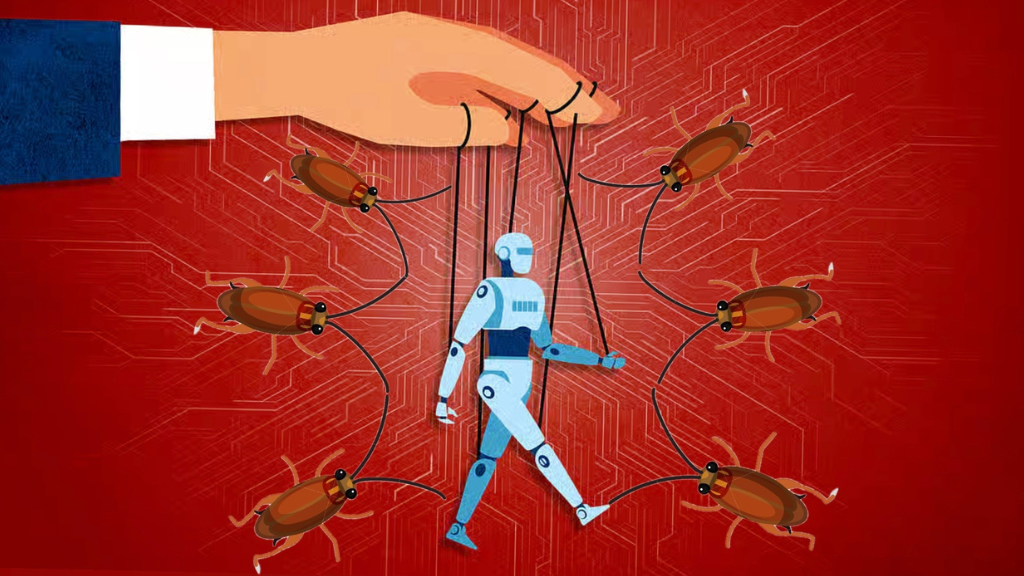
The capacity to produce high-quality visual political content, including imagery, video, and textual materials, has been democratised to a degree that would have been inconceivable in previous political communication cycles. The CJP’s distinctive cockroach-man imagery, which became one of the most widely circulated visual political symbols in recent Indian digital history, was produced through generative AI platforms available to any individual with a smartphone and a basic internet connection. The financial and technical barriers that previously restricted the production of such content to professional communications operations no longer operate as effective gatekeepers.
The distribution architecture of Instagram’s recommendation algorithm constitutes a second and equally significant technological factor. The platform’s content promotion system operates through a sequential escalation mechanism in which early engagement signals, measured primarily through likes, shares, and saves within a defined initial window, are used to determine whether content merits broader distribution. Content that performs strongly in this initial window is escalated to progressively larger audience segments, with each round of escalation generating additional engagement that triggers further distribution. The CJP’s visual format was precisely calibrated for performance within this architecture. Its imagery was immediately legible, emotionally resonant, and highly shareable, characteristics that consistently predict strong performance within Instagram’s recommendation system. The result was an exponential growth curve in which the platform’s own promotional infrastructure functioned as an amplification mechanism for content that had already achieved critical engagement mass.
Independent empirical research supports the contextual analysis of why this content found such a receptive audience at this particular moment. A Bloomberg Economics study completed in late 2025, which analysed a dataset of more than 22 million observations relating to Gen Z political behaviour across multiple national contexts, identified a statistically robust correlation between the combination of high digital penetration, young population demographics, and concentrated economic anxiety on the one hand, and elevated levels of online political mobilisation on the other. India’s position on each of these variables places it among the countries where this mobilisation dynamic is most likely to manifest with particular intensity.
Why This Is a Sign of Democratic Strength
The appropriate analytical framework for understanding the CJP’s follower base is provided by Robin Dunbar’s research on the cognitive architecture of human social relationships. Dunbar’s work established that the human brain’s capacity for maintaining stable social relationships is bounded at approximately 150 individuals, a constraint that reflects the neurological demands of the social monitoring and reciprocity maintenance that characterise genuine relationships.
Digital social networks do not overcome this constraint. Rather, they create a categorically different form of social connection, characterised in the network science literature as a weak tie, which transmits shared sentiment and identity signals without requiring the cognitive investment of genuine relationship formation. The CJP’s 20 million followers overwhelmingly represent weak-tie connections. The individuals concerned expressed a sentiment through a digital interaction but did not commit to an ongoing relationship with the movement or its institutional ambitions. This characterisation is analytically significant because weak-tie mobilisation around a satirical political symbol carries specific implications for how the phenomenon should be understood. The scale of the mobilisation indicates a high level of ambient political frustration and digital engagement.
The satirical register in which that frustration is expressed indicates a population with sufficient democratic confidence to process political dissatisfaction through humour rather than confrontation. The peaceful character of the movement, which Dipke has explicitly and consistently emphasised, confirms that the mobilisation is operating within rather than against the established parameters of democratic participation. These characteristics, taken together, constitute a positive indicator of democratic health rather than a negative indicator of democratic dysfunction. The material preconditions for this form of democratic participation were created through deliberate public policy investment. The Indian government’s decade-long commitment to digital inclusion, expressed through programmes including PM-WANI for rural connectivity, the Digital India initiative, and the Jan Dhan-Aadhaar-Mobile framework for financial inclusion and digital access, established the infrastructure through which this mobilisation became possible.
The causal relationship is direct: the young Indians who generated a 20-million-follower movement in five days were able to do so because they had access to the digital infrastructure that public investment created. The appropriate governmental response to this outcome is recognition that the investment in democratic access produced the democratic participation it was designed to enable.
Solutions for Government, Platforms, and Citizens
A phenomenon of this character and scale generates analytical obligations for each of the three principal stakeholders in India’s digital democratic ecosystem, and the appropriate response from each is distinct. For government, the analytically sound response involves institutionalising mechanisms through which the signals generated by digital political mobilisation can be received, processed, and incorporated into policy development in a structured and accountable manner. Extending the Digital India mandate to incorporate a formal civic technology layer would create channels through which young citizens can submit structured policy concerns and track governmental responses with genuine transparency.
A national youth sentiment monitoring system, built on natural language processing of publicly available social media data and published on a regular schedule, would provide policymakers with systematic information about the specific concerns driving digital political engagement. A dedicated institutional capacity within the ministries of Labour and Education, mandated to translate the demands articulated in digital political movements into time-bound policy proposals with publicly committed response timelines, would close the accountability gap between online political expression and institutional action. An annual structured dialogue, administered through an accessible digital platform such as MyGov, would institutionalise the responsiveness that the current moment demands.
For platforms, the analytical imperative is the development of more sophisticated content governance frameworks capable of distinguishing between satirical political expression, which merits constitutional protection and should be treated accordingly, and genuinely harmful content, which merits restriction. Current moderation architectures are inadequate for making this distinction at scale. Investment in AI-powered content classification tools, developed in consultation with India’s constitutional free speech framework, would produce a more defensible governance environment.
Algorithmic transparency mechanisms, providing users with accessible information about the principles governing content promotion decisions, would reduce the democratic distortions produced by the current opacity of recommendation systems. And systematic data sharing with researchers and policymakers on the demographic and geographic characteristics of viral political mobilisation would support more calibrated and effective institutional responses to future episodes. For citizens, the analytically appropriate intervention is the creation of structured pathways through which digital political energy can be converted into formal institutional participation. Civic technology that connects online petition activity directly to formal parliamentary mechanisms would reduce the distance between digital sentiment and democratic consequence.
Civic education programmes, integrated into existing educational frameworks, that teach the history of India’s democratic movements and demonstrate how digital tools extend rather than replace those traditions, would equip young citizens with the historical literacy necessary to participate effectively in formal democratic processes. Capacity building programmes, housed within established institutions of higher education, that develop the organisational and advocacy skills of digital movement participants, would extend the temporal horizon of mobilisation beyond the initial viral moment.
The Conclusion
The analytical conclusion warranted by the available evidence is straightforward. Twenty million followers in five days represents not a democratic pathology but a democratic indicator of considerable significance. The Indian democratic tradition has consistently demonstrated the capacity to incorporate new communicative technologies into its political processes without losing its fundamental institutional coherence. The freedom movement utilised the pamphlet and the public meeting. The anti-corruption movement of 2011 utilised television and the emerging social media landscape. The CJP is utilising generative artificial intelligence and algorithmic distribution networks. The technology changes across each of these episodes.
The democratic aspiration that animates the participation does not. India’s institutions are well-equipped to hear what the CJP is saying. The more important question is whether they have the institutional architecture to respond to it constructively. Building that architecture is the task the CJP moment has made urgent.
Dr. Sudhanshu Kumar is a Subject Matter Expert on AI, Cyberwarfare and Cybersecurity at CENJOWS (Centre for Joint Warfare Studies), HQ (IDS), Ministry of Defence, New Delhi. He holds a PhD on “AI in Russian defence and Security policy” from the School of International Studies in JNU. He is also a Visiting Research Fellow at MGIMO, Moscow.