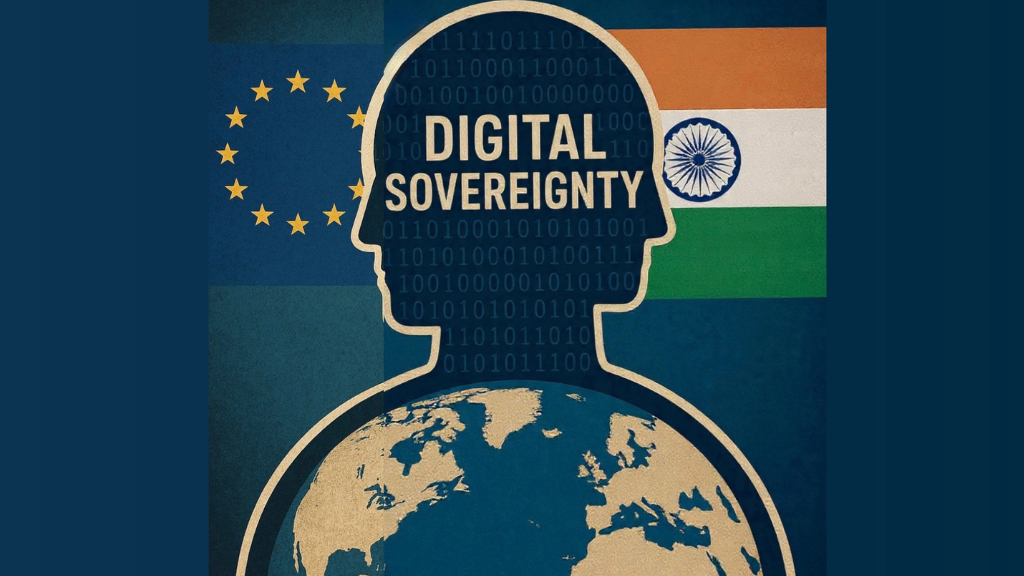
Why two messy democracies are building the only credible alternative to Silicon Valley surveillance and Beijing’s control.
Let me tell you about two things that happened last month that nobody connected.
In Brussels, European Commission Executive Vice President Teresa Ribera slapped Google with a €2.95 billion fine. Washington threatened retaliation. She didn’t blink.
In New Delhi, India’s Ministry of Electronics quietly announced twelve sovereign AI models launching this month. Trained on Indian data. Hosted on Indian servers. No American cloud providers involved.
These aren’t random policy moves. They’re symptoms of the same problem: digital colonialism.
And for the first time in years, I actually think something might change.
The Problem Nobody Wants to Name
Here’s the uncomfortable truth: India and Europe have handed over digital sovereignty to five American corporations.
Meta harvests biometric data from Indian users like it’s mining coal. Google manipulates search results across European markets to favor its own services. Amazon’s cloud infrastructure hosts critical government data from both regions, and under the US CLOUD Act, American intelligence agencies can access it whenever they want. Apple takes a 30% cut from every developer in Bangalore and Brussels.
Two of the world’s largest democratic regions, nearly 2 billion people combined, are essentially tenants in someone else’s digital empire.
For years, this felt inevitable. “That’s just how the internet works,” we told ourselves.
But 2026 is different.
Trump Changed the Calculation
Donald Trump’s return to the White House broke the illusion that American tech hegemony comes with stability.
His administration is now threatening 25% tariffs on European exports because Europe dared to enforce its own competition laws. Meanwhile, his erratic chip export controls are creating chaos for India’s semiconductor ambitions.
The message is clear: dependence on American infrastructure means your digital future is hostage to whoever controls the White House. And right now, that’s not exactly reassuring.
But here’s the twist. China isn’t offering a better alternative.
Beijing’s Digital Silk Road has already captured 50% of Southeast Asian e-commerce through Alibaba and TikTok. It comes bundled with state surveillance, political influence, and a governance model that makes democratic accountability impossible.
So if you’re India or Europe, you’re stuck between American unpredictability and Chinese coercion.
Unless you build a third option.
Why This Partnership Actually Makes Sense
I’ve watched a lot of international tech partnerships get announced with great fanfare and die quietly in bureaucratic limbo. This one feels different because the incentives finally align.
India brings scale.
Four semiconductor fabs are starting production this year. The target is 70% domestic chip capability by 2029. India also has 19% of the world’s chip designers and a proven track record of scaling digital infrastructure to 1.4 billion people through systems like Aadhaar, UPI, and DigiLocker.
Europe brings enforcement power.
The Digital Markets Act has imposed over €3 billion in fines against Big Tech since 2025. Europe has shown it’s willing to force structural changes, including potential divestitures. Germany’s Sovereign Tech Agency has invested €23.5 million in maintaining critical open-source infrastructure. These aren’t symbolic gestures. They’re actual shifts in power.
Both reject the binary.
India and Europe don’t want American corporate surveillance or Chinese state control. They want a rules-based system that respects individual rights while enabling innovation. That philosophical alignment matters more than people realize.
The India-EU Trade and Technology Council, formalized on January 27 in the Comprehensive Strategic Agenda, isn’t just another diplomatic press release. It institutionalizes cooperation on AI, semiconductors, and digital governance.
But Here’s Where It Gets Messy
Partnership rhetoric is easy. Implementation is brutal.
First problem: India’s surveillance loopholes.
India’s Digital Personal Data Protection Act has sweeping state exemptions for national security and public order. No proportionality tests. No independent oversight. The Data Protection Board is government-appointed, not independent like European authorities.
This creates an awkward paradox. How do you build a partnership claiming democratic legitimacy when one partner’s legal framework enables exactly the kind of surveillance capitalism you’re trying to escape?
European regulators have already denied India “data adequate” status under GDPR. That’s not a small thing. It means cross-border data flows between the two regions face legal friction that won’t disappear through goodwill.
Second problem: data localization vs. flexibility.
India wants data localization for sovereignty reasons. Europe prefers adequacy-based frameworks that enable cross-border innovation. India’s vague rules around “Significant Data Fiduciaries” impose compliance costs that make European companies hesitant to invest in Indian digital infrastructure.
This isn’t just technical. It reflects fundamentally different development philosophies.
Third problem: capital intensity.
Building sovereign digital infrastructure is expensive. Really expensive.
India has committed $1.3 billion for semiconductor fabs and $150 billion for AI infrastructure. Europe is dealing with defense rearmament and climate transition costs. Neither has demonstrated the sustained capital commitment this actually requires.
For context, the US and China are operating at completely different scales. Without matching that capital intensity, the partnership risks becoming performative.
Fourth problem: institutional fragmentation.
India has center-state regulatory divergence. Europe has 27 member states with different priorities. The India-EU Free Trade Agreement has been negotiating since 2007 and still isn’t done.
Bureaucratic complexity kills momentum.
So What Actually Needs to Happen?
If this partnership is going to be more than photo ops, here’s what has to change.
Get realistic about sequencing.
Stop talking about displacing Google or Meta in five years. That’s fantasy. Instead, focus on areas where India and Europe have genuine competitive advantages.
Clean technology supply chains make sense. India’s renewable energy market is projected to hit $90 to 135 billion by 2030. Semiconductor design and advanced packaging, not full-stack manufacturing. Digital public infrastructure rollout in Southeast Asia’s 402 million internet users.
Win in those domains first. Build credibility. Then expand.
India needs governance reform.
This is uncomfortable but necessary. Strengthen Data Protection Board independence. Narrow state exemptions with proportionality standards, sunset clauses, and judicial review. Establish transparent oversight.
Without these reforms, European partners will always question whether India’s sovereign AI infrastructure serves citizens or surveils them. Democratic legitimacy can’t be claimed through press releases. It has to be institutionalized.
Put money where the rhetoric is.
Establish an India-EU Digital Innovation Fund. €5 to 10 billion over five years to co-invest in startups, open-source projects, and joint infrastructure. Fund ASEAN digital public infrastructure rollout through the ASEAN-India Digital Work Plan with EU technical support.
Capital signals seriousness. Everything else is just talk.
Use ASEAN as the proving ground.
Southeast Asian nations are desperately looking for alternatives to Chinese digital dominance and American corporate extraction. They have 402 million internet users and a growing digital economy.
An India-EU partnership offering transparent governance, open standards, and capacity building can position both regions as credible partners. If you can demonstrate viability in even three ASEAN countries, the model becomes exportable globally.
Create accountability mechanisms.
Independent monitoring of regulatory convergence, institutional capacity building, and partnership milestones. Transparency builds trust. Opacity breeds skepticism.
No more “joint working groups” that disappear after the summit ends.
What’s Actually at Stake Here
This isn’t really about technology. It’s about whether democracies can build digital systems that reflect democratic values.
Right now, the answer is no. We’ve outsourced that work to corporations optimizing for engagement and profit, or to authoritarian states optimizing for control.
China’s model spreads through infrastructure dependency. America’s model persists through monopolistic lock-in and network effects. Neither serves genuine sovereignty.
India and Europe have complementary capabilities to build a third way. But capability without political will just produces more ministerial photo opportunities.
The window is narrow. China is consolidating digital control in ASEAN. Trump’s chaos is deepening. Big Tech is entrenching further through AI investments that make switching costs even higher.
February 2026 offers synchronized momentum. India’s AI summit is happening this month. The EU-India Strategic Agenda is being implemented. Semiconductor MOUs are being activated.
If both sides can align commitments and funding now, this partnership has a shot.
If they don’t, we’ll look back in five years and wonder why democracies couldn’t cooperate on the most important infrastructure challenge of our generation.
The Choice Nobody’s Making Explicit
Partnership won’t end digital colonialism within a decade. Let’s be honest about that.
But it can disrupt duopolistic control in specific critical domains. It can offer developing nations democratic alternatives. It can prove that sovereignty and innovation aren’t mutually exclusive.
The question isn’t whether an India-Europe partnership is ideal. It’s whether democracies can afford to remain fragmented while authoritarian alternatives and corporate monopolies define the digital future for everyone else.
Because the alternative to trying isn’t the status quo.
It’s surrender, one data point at a time.
And I don’t know about you, but I’d rather bet on two messy, bureaucratic, imperfect democracies figuring this out than accept that as inevitable.
What do you think? Is an India-EU tech alliance realistic, or am I being too optimistic about institutional cooperation? Hit reply or drop a comment. I read everything.
The author is a Subject Matter Expert on AI and Cyberwarfare at CENJOWS( Centre for Joint Warfare Studies), HQ IDS, Ministry of Defence, New Delhi. The author is also a Visiting Research Fellow at MGIMO, Moscow and pursuing his PhD on “AI in Russia” from School of International Studies, JNU.