A Security Gap Exposed
Poland’s decision to spend roughly $4.3 billion on a nationwide anti-drone defense system marks a turning point in how European states are thinking about air security. What Warsaw is building is not merely another layer of missile defense, but a response to a specific vulnerability revealed by the war in Ukraine: the ability of low-cost drones to penetrate borders, drain expensive interceptor systems, and create strategic pressure without triggering full-scale escalation.
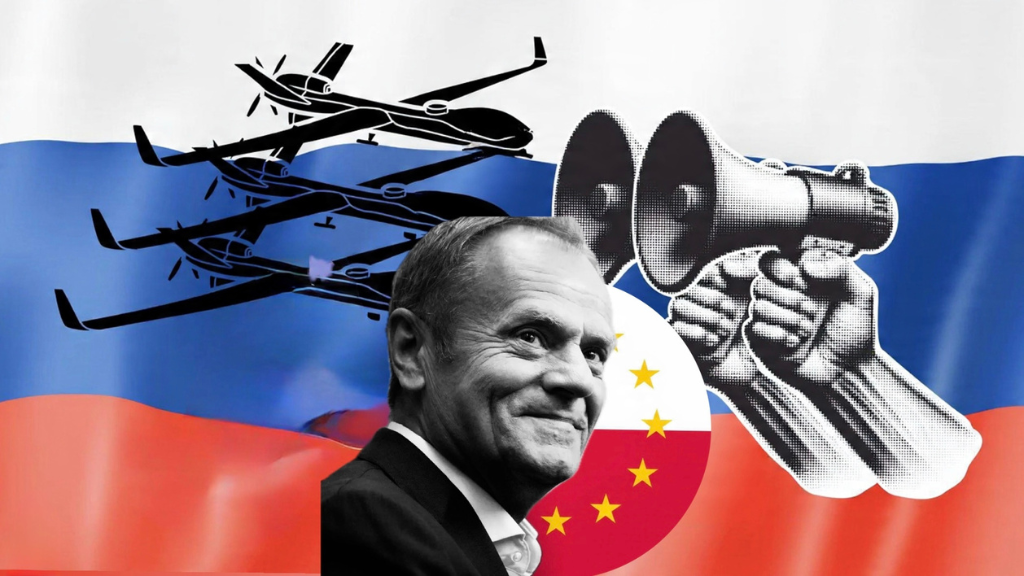
The so-called “drone wall” will be constructed by Poland’s state-owned defense group Polska Grupa Zbrojeniowa together with Norway’s Kongsberg Defence & Aerospace. According to Polish officials, it will integrate radar systems, electronic jamming, machine guns, and short-range missiles into a single network designed to track and neutralize unmanned aerial vehicles before they can cause damage. Prime Minister Donald Tusk described it as an unprecedented system in Europe, an assessment that reflects how quickly the threat environment has shifted since Russia’s invasion of Ukraine.
The Incident That Changed the Calculation
The urgency behind the project can be traced to a September incident in which around twenty drones crossed into Polish airspace during a Russian strike on Ukraine. NATO aircraft were scrambled and costly air-defense missiles were used against relatively cheap unmanned systems. While the intrusion caused no major damage, it exposed a strategic dilemma: traditional air defenses were built to stop aircraft and ballistic missiles, not swarms of disposable drones costing a fraction of an interceptor missile’s price.
This asymmetry has become one of the defining features of the Ukraine war. Russia and Ukraine alike have demonstrated how commercial or semi-militarized drones can perform reconnaissance, guide artillery, and strike infrastructure at minimal cost. For countries bordering the conflict zone, the risk is not necessarily a deliberate attack, but spillover, navigation errors, electronic warfare interference, or deliberate probing of NATO’s response thresholds.
Poland’s Strategic Position
Poland sits at the center of this vulnerability. It is both a frontline NATO state and a major logistical hub for military aid flowing into Ukraine. Its airspace is therefore strategically sensitive, and any repeated drone intrusions carry political as well as military consequences. Each interception raises questions about escalation, alliance credibility, and the sustainability of current defense methods.
The logic of the drone wall is rooted in efficiency. Shooting down a drone with a fighter jet or a surface-to-air missile is technologically impressive but economically irrational if done at scale. A layered system that includes jammers and kinetic low-cost interceptors is intended to close that gap. Instead of relying solely on high-end missile batteries, Poland aims to create a defensive mesh that can absorb frequent small incursions without exhausting strategic reserves.
European Financing and Political Meaning
Financing is another critical dimension. The project will be partially funded through the European Union’s SAFE defense loan program, under which Poland is expected to receive roughly €44 billion, making it the largest beneficiary of the scheme. This underscores how drone defense is no longer treated as a niche military issue but as a continental security concern. Brussels’ involvement also reflects a broader EU shift toward joint financing of defense capabilities, something that would have been politically unthinkable a decade ago.
The industrial consequences are equally significant. Kongsberg has announced plans to expand manufacturing capacity in Poland, embedding foreign defense technology within the Polish economy. This deepens Poland’s role in Europe’s arms production network and aligns with Warsaw’s broader ambition to become a major military power within NATO’s eastern flank. In practical terms, it means that the drone wall is not only a defensive project but also an investment in domestic military-industrial infrastructure.
Deterrence Without Escalation
Strategically, the system sends a signal to Moscow without crossing the line into provocation. It is defensive, territorial, and framed as a response to technological change rather than political confrontation. Yet it still alters the strategic environment by reducing Russia’s ability to use drones as low-risk tools of intimidation near NATO borders. The more resilient Poland’s airspace becomes, the less useful such incursions are as instruments of pressure.
At the same time, the project highlights a deeper transformation in warfare. Air defense is no longer just about preventing catastrophic strikes; it is about managing constant low-level threats. The battlefield is no longer confined to war zones but extends into civilian infrastructure, border regions, and digital command systems. An “intelligent” defense network implies not only hardware but also data integration, algorithmic tracking, and automated response decisions. This introduces new questions about reliability, escalation control, and the role of human judgment in air defense.
Limits and Risks of the Drone Shield
There is also a political message inside the European Union. Poland has often portrayed itself as a security realist within a bloc historically hesitant about militarization. By tying the drone wall to EU funding and multinational industry partnerships, Warsaw is framing hard defense spending as compatible with European integration rather than opposed to it. This could strengthen Poland’s influence in shaping future EU defense priorities.
Critics may question whether such systems can truly keep pace with rapidly evolving drone technology. Electronic countermeasures can be circumvented, and cheap drones can be produced in large numbers. No shield is impermeable. However, the objective is not perfect protection but deterrence by denial: making intrusions costly enough to discourage routine use. In that sense, the drone wall is less a fortress and more a filter.
A Model for Europe’s Security Future
Ultimately, Poland’s initiative reflects a broader lesson of the Ukraine war: future conflicts will be shaped not only by tanks and missiles but by networks of sensors, software, and low-cost aerial platforms. Borders are now tested from the air by devices that blur the line between military hardware and consumer electronics. States that fail to adapt risk bleeding resources in asymmetrical exchanges.
Poland’s $4.3 billion bet is therefore not simply about stopping drones. It is about redefining what air defense means in an era where threats are small, frequent, and technologically agile. If successful, the drone wall could become a model for other European states confronting similar risks. If it fails, it will serve as a costly lesson in how difficult it is to defend against weapons designed to be expendable.
Either way, the project signals that Europe is preparing for a security future shaped less by spectacular missile strikes and more by persistent, low-level aerial pressure. In that future, walls will not be made of concrete or steel, but of sensors, code, and layered responses, built not to stop armies, but to manage the politics of constant technological intrusion.