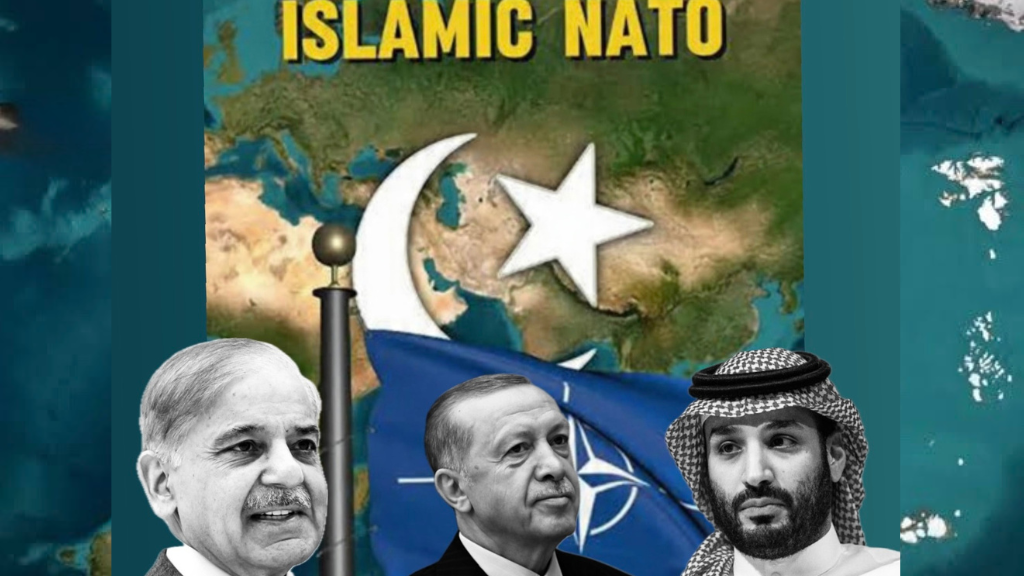
The idea of an “Islamic Nato” has returned to geopolitical debate at a moment when established security architectures across West Asia and beyond are under strain. Reports that Turkey may join a defence arrangement already taking shape between Saudi Arabia and Pakistan have sharpened this discussion. Although still informal, the emerging alignment carries echoes of NATO’s collective security model and reflects deeper shifts in how regional powers perceive threats, alliances, and the reliability of external guarantors.
Rather than a sudden military bloc, the concept points to a gradual convergence of interests among key Muslim-majority states seeking greater strategic autonomy in an increasingly fragmented global order.
The Origins of the Concept
The notion of a NATO-style security mechanism among Islamic and Arab states is not new, but recent events have given it renewed urgency. At an emergency summit convened last September by the Arab League and the Organisation of Islamic Cooperation (OIC), Egypt proposed the creation of a joint task force capable of coordinated military action during regional crises.
This call came amid heightened tensions following Israel’s surprise strike on Doha, reportedly aimed at senior Hamas figures. The incident unsettled long-standing assumptions in the Gulf about deterrence and protection. In response, the six Gulf Cooperation Council states, Saudi Arabia, the UAE, Qatar, Kuwait, Oman and Bahrain, reaffirmed their commitment to a joint defence agreement signed in 2000, which treats an attack on one member as an attack on all.
Iraq’s Prime Minister Mohammed Shia al-Sudani endorsed a collective approach to regional security, while Pakistan pushed for a joint force to monitor and counter what it described as Israeli expansionism. Within weeks, Saudi Arabia and Pakistan announced a “strategic mutual defence agreement” declaring that aggression against either would be considered aggression against both, a formulation closely resembling NATO’s Article 5.
Turkey’s Strategic Calculus
Turkey’s reported interest in joining this emerging defence understanding has added a critical new layer. According to Bloomberg, discussions are well advanced, with officials suggesting a deal is likely.
Ankara’s motivations are rooted in both opportunity and uncertainty. As a long-standing NATO member with the alliance’s second-largest military, Turkey has grown increasingly uneasy about the predictability of Western security commitments, particularly as US foreign policy becomes more transactional. Questions over Washington’s long-term role in West Asia and its unwavering prioritisation of Israel have encouraged regional actors to explore alternative security mechanisms.
For Turkey, alignment with Saudi Arabia and Pakistan offers a platform to expand influence across South Asia, West Asia and parts of Africa, while reinforcing its defence-industrial ambitions. Saudi Arabia brings financial depth, Pakistan contributes nuclear capability, ballistic missiles and manpower, and Turkey adds operational experience and a rapidly growing arms industry. Together, they represent a complementary mix of resources rarely concentrated within a single regional framework.
A Challenge to Established Security Models
Geopolitically, the significance of this alignment lies less in its formal structure and more in what it signals: a slow erosion of the post–Cold War security order in the Middle East. For decades, Gulf security rested on external protection, primarily from the United States under an implicit bargain of economic and political alignment in exchange for military guarantees.
That model is now under stress. The attack on Doha exposed vulnerabilities in the existing deterrence architecture, while regional conflicts have demonstrated the limits of reliance on external powers. As a result, there is growing interest in intra-regional security cooperation that reduces dependence on Washington.
Yet important constraints remain. Analysts such as Andreas Krieg of King’s College London argue that a true NATO-style alliance is unlikely in the near term. Binding collective-defence obligations would risk pulling states into conflicts they do not see as existential, such as large-scale wars involving Israel or disputes among rival regional actors. Gulf monarchies, in particular, remain cautious about surrendering strategic flexibility.
Strategic Convergence Without Formalisation
From a geopolitical standpoint, the emerging “Islamic Nato” is better understood as a strategic convergence rather than a fixed alliance. Defence cooperation among Turkey, Saudi Arabia and Pakistan is already deepening through arms transfers, joint projects, technology sharing and political coordination. These ties enhance deterrence and bargaining power without the rigidity of a formal treaty structure.
Such arrangements allow participants to signal unity and capability while avoiding the political and military costs of an Article 5–style commitment. In this sense, the alignment reflects a broader global trend: flexible, interest-based coalitions replacing rigid alliance blocs.
An Evolving Security Landscape
Whether or not an “Islamic Nato” ever takes institutional form, the conversation itself marks a turning point. It highlights a region reassessing its security assumptions, recalibrating relationships with global powers, and experimenting with new mechanisms of cooperation.
In a world where traditional alliances are questioned and strategic uncertainty is the norm, the convergence of Turkish military capacity, Pakistani deterrence and Saudi resources represents not a revolution, but a clear signal: regional powers are increasingly intent on shaping their own security environment rather than relying solely on external guardians.