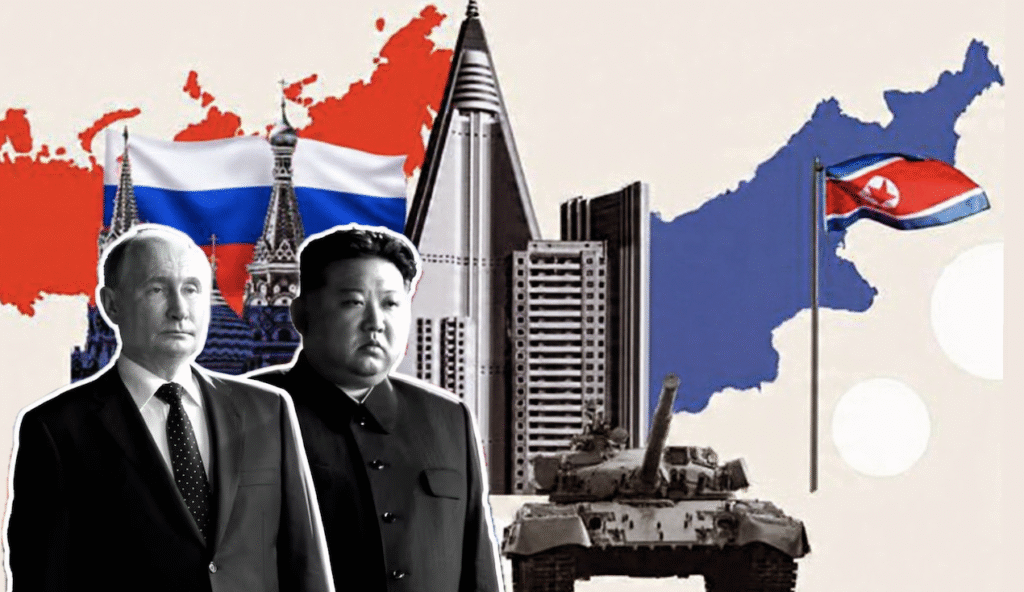
North Korean leader Kim Jong-un’s New Year greeting to Vladimir Putin carried an unusually stark phrase for diplomatic messaging: Pyongyang and Moscow, he said, had shared “blood, life and death” in the war in Ukraine. Published by the state-run Korean Central News Agency (KCNA), the message framed 2025 as a “really meaningful year” for bilateral ties, elevated not by treaties or rhetoric alone, but by what Kim described as fighting “in the same trench.”
The language was striking not just for its intensity, but for what it confirmed. North Korea is no longer a distant political supporter of Russia’s war effort. It is now an active military participant, one willing to absorb casualties and publicly acknowledge them.
From Silent Support to Battlefield Participation
For months, Western intelligence agencies had alleged that North Korea was supplying Russia with ammunition, missiles, and eventually manpower. Those claims hardened into confirmation in April, when Pyongyang acknowledged that it had deployed troops to support Russia’s military campaign against Ukraine, and that North Korean soldiers had been killed in combat.
Earlier this month, North Korea went further, confirming that its troops were sent to Russia’s Kursk region in August 2025 to clear mines, an admission that placed North Korean personnel inside Russian territory during an active phase of the war. Mine-clearing is dangerous, frontline-adjacent work, reinforcing Kim’s claim that the alliance has crossed into shared sacrifice.
Kim’s framing of the relationship as one sealed by blood serves multiple purposes. Domestically, it reinforces the narrative of North Korea as a wartime state standing shoulder to shoulder with a major power. Internationally, it signals defiance, an assertion that sanctions, isolation, and diplomatic pressure have failed to prevent Pyongyang from shaping the battlefield.
Kyiv Under Fire as the War Escalates
Kim’s message came as Ukraine endured another wave of intense attacks. Several powerful explosions rocked Kyiv on Saturday, prompting city authorities to warn residents to seek shelter. Mayor Vitali Klitschko confirmed that air defence systems were active across the capital as missiles and drones approached.
Ukraine’s air force issued a nationwide air alert, reporting missile and drone activity across multiple regions, including Kyiv. Journalists on the ground heard repeated detonations, some accompanied by bright flashes that briefly lit the skyline orange. Military-linked Telegram channels reported the use of both cruise and ballistic missiles in the assault.
The timing underscored a grim reality: as Russia expands its diplomatic and military partnerships, the intensity of strikes on Ukrainian cities has not abated. If anything, the war appears to be broadening geographically and politically.
Moscow, Washington, and a Fracturing Peace Track
Against this backdrop of escalation, Moscow has accused the European Union of attempting to sabotage a potential agreement between Russia and Ukraine. Russian Deputy Foreign Minister Sergei Ryabkov said Brussels was working to “torpedo” proposals ahead of a planned meeting between Ukrainian President Volodymyr Zelenskyy and former US President Donald Trump in Florida.
Ryabkov argued that a proposal drafted with Zelenskyy’s input “differs radically” from earlier points discussed between US and Russian officials. He suggested that any deal must remain within parameters allegedly fixed during a Trump–Putin meeting in Alaska in August, warning that deviations would make a final accord impossible.
The comments reveal a fragmented diplomatic landscape: Washington, Brussels, Kyiv, and Moscow appear to be working from different assumptions about what peace might look like—and who gets to define it.
Belarus, Civilians, and the Expanding Theatre of War
Zelenskyy has meanwhile accused Russia of using Belarusian territory in ways that put civilians directly at risk. According to Ukrainian intelligence, Russian forces are deploying equipment on residential buildings in Belarus near the Ukrainian border to guide drone strikes.
“Antennae and other equipment are located on the roofs of ordinary five-storey apartment buildings,” Zelenskyy said, alleging that the infrastructure helps direct Shahed drones toward western Ukrainian regions. He described the tactic as a “complete disregard for human lives,” widening concerns about Belarus’s role in the conflict.
These claims come amid growing evidence that Belarus is becoming more deeply integrated into Russia’s military posture not just as a launchpad, but as a potential strategic base.
Hypersonic Signals: Oreshnik Missiles in Belarus?
Two US researchers, Jeffrey Lewis and Decker Eveleth, have raised alarms over satellite imagery suggesting Russia may be preparing to station nuclear-capable Oreshnik hypersonic ballistic missiles at a former airbase in eastern Belarus.
After analysing images from Planet Labs, the researchers said they were 90 percent confident that mobile Oreshnik launchers could be deployed near the town of Krichev, roughly 307 kilometres east of Minsk. The imagery reportedly shows rapid construction beginning in early August, including features consistent with a Russian strategic missile base.
One notable indicator, according to Eveleth, is a military-grade rail transfer point enclosed by security fencing—suggesting the site could receive missiles and launchers by train. If confirmed, the deployment would significantly alter NATO’s security calculations in Eastern Europe.
Territorial Gains and the Grind of Ground War
On the battlefield, Russia claims incremental progress. Its defence ministry announced the capture of the village of Kosivtseve in Ukraine’s south-eastern Zaporizhzhia region, north of the embattled town of Huliaipole. Moscow said its forces secured more than 23 square kilometres of territory, positioning the “east” group of forces for further offensives.
According to the ministry, drones were deployed to block Ukrainian reinforcements from entering Huliaipole, highlighting how aerial surveillance and unmanned systems have become central to territorial control.
While such claims are difficult to independently verify, they point to a grinding war of attrition, one increasingly sustained by external partners like North Korea.
An Alliance Forged in War
Kim Jong-un’s declaration of shared “blood, life and death” is more than symbolic flourish. It marks the normalization of a wartime alliance that would have seemed unthinkable just a few years ago. North Korea, long isolated and sanctioned, has found in Russia not only a diplomatic shield but a battlefield partner.
For Moscow, Pyongyang offers manpower, munitions, and political loyalty at a time when the war is stretching Russian resources. For Kim, the alliance brings relevance, leverage, and a seat, however informal at the table of a conflict reshaping global power lines.
As missiles strike Kyiv, diplomacy falters, and new fronts quietly open in Belarus, one conclusion is unavoidable: the war in Ukraine is no longer confined to two countries. It is evolving into a broader confrontation, with alliances defined not just by interests, but by who is willing to bleed together.