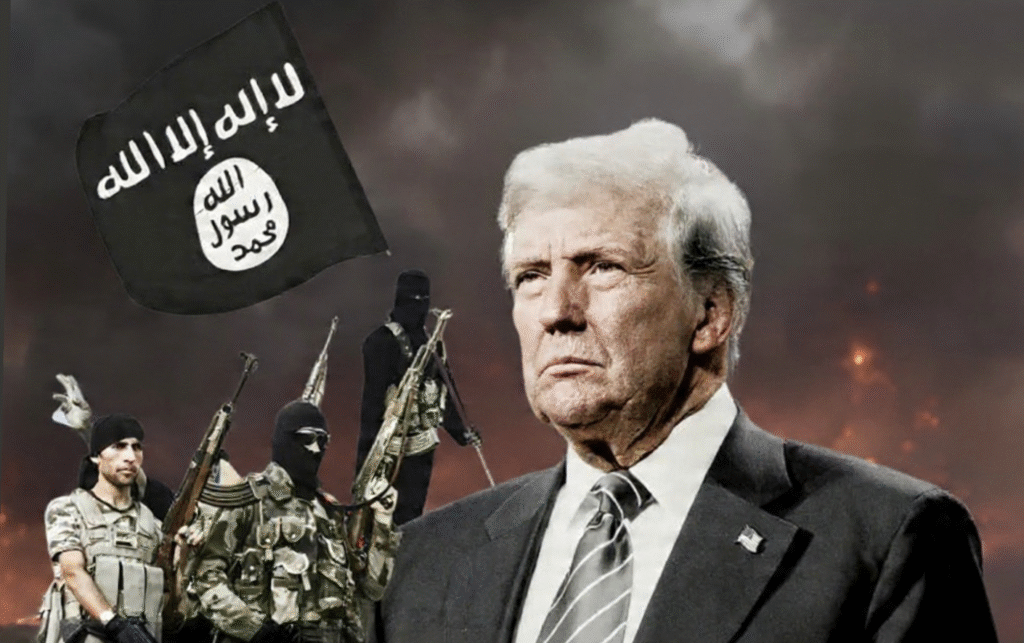
President Donald Trump announced Thursday that the United States carried out a series of military strikes against Islamic State fighters operating in northwestern Nigeria, marking a rare direct American intervention in Africa’s most populous country. The operation, framed by the White House as a response to the killing of Christians, underscores both the administration’s hardening stance toward Islamist militancy and the complex realities of Nigeria’s long-running internal violence.
What the U.S. Attack Involved
According to a U.S. military official, the strikes were conducted using more than a dozen Tomahawk cruise missiles launched from a U.S. Navy vessel positioned in the Gulf of Guinea. The missiles targeted two Islamic State camps in Sokoto State, near Nigeria’s border with Niger.
U.S. Africa Command said its initial assessment indicated that “multiple” ISIS fighters were killed. While damage assessments are ongoing, officials emphasized that the strikes were conducted in coordination with the Nigerian military, a point later confirmed by Nigeria’s Ministry of Foreign Affairs.
The operation followed weeks of intelligence-gathering surveillance flights over large parts of Nigeria, which U.S. officials say began in late November.
Trump’s Framing: Protecting Christians
In a post on Truth Social, Mr. Trump described the operation in blunt terms, saying the United States had launched a “powerful and deadly strike” against ISIS militants who he claimed were “viciously killing, primarily, innocent Christians at levels not seen for many years.”
That framing is consistent with pressure from Christian evangelical groups and senior Republican lawmakers who have increasingly argued that Christians in Nigeria are being systematically targeted. Last month, Mr. Trump ordered the Defense Department to prepare options for military intervention in Nigeria, explicitly citing the need to protect Christian communities.
Defense Secretary Pete Hegseth reinforced that message on social media Thursday, writing that the president had been “clear” that the killing of Christians in Nigeria “must end,” adding that ISIS had “found out tonight — on Christmas.”
Nigeria Pushes Back on ‘Genocide’ Claims
Nigerian authorities, while welcoming U.S. cooperation, have consistently rejected claims that the country is experiencing a Christian genocide. Officials point out that Nigeria’s violence cuts across religious lines and involves a patchwork of actors, including jihadist groups, criminal gangs, and armed bandits.
Kimiebi Ebienfa, a spokesperson for Nigeria’s foreign ministry, said the strikes were conducted with the government’s approval but stressed that “terrorist violence in any form — whether directed at Christians, Muslims, or other communities — remains an affront to Nigeria’s values.”
Indeed, many of the victims of extremist violence in Nigeria are Muslim civilians, particularly in the northeast, where jihadist groups have been active for more than a decade.
Who Was Targeted: ISIS in the Sahel
The strikes focused on a faction known as Islamic State–Sahel, which operates along Nigeria’s porous border with Niger. According to counterterrorism analysts, the group has expanded its reach in recent years, attacking both civilians and security forces.
This is distinct from Boko Haram and its splinter group, the Islamic State West Africa Province (ISWAP), which dominate Nigeria’s northeast and have killed tens of thousands since 2009. While Boko Haram remains the most notorious name associated with Nigeria’s insurgency, ISIS-linked factions elsewhere in the country have grown more lethal and more organized.
A Limited Strike in a Deeply Entrenched Conflict
Even as the Pentagon prepared strike options in November, American military planners privately cautioned that airstrikes alone were unlikely to alter the trajectory of Nigeria’s conflict. In the northwest, where Thursday’s attack occurred, much of the violence is driven by armed gangs engaged in mass kidnappings for ransom rather than ideological jihad.
Nigeria is not formally at war, yet it remains one of the deadliest countries in the world. More than 12,000 people were killed by various violent groups this year, according to conflict monitoring data, surpassing tolls in several active war zones.
The scale and fragmentation of violence raise questions about whether targeted U.S. strikes can produce lasting security gains without broader political and security reforms inside Nigeria.
Part of a Broader Anti-ISIS Campaign
The Nigeria strikes marked the second U.S. military action against Islamic State targets in a single week. Days earlier, American forces carried out dozens of airstrikes against ISIS positions in Syria following a deadly attack that killed two U.S. soldiers and a civilian interpreter.
Together, the operations suggest a renewed emphasis by the Trump administration on direct military retaliation against Islamic State affiliates, even in regions where U.S. involvement has historically been limited.
In his Truth Social post, Mr. Trump vowed that “under my leadership, our Country will not allow Radical Islamic Terrorism to prosper,” ending with a holiday message that mixed religious language with a warning of further force.
Whether the strikes in Nigeria represent a one-off intervention or the beginning of a deeper U.S. role in Africa’s security crises remains unclear. What is certain is that the violence they aim to confront is far more complex and entrenched than any single military operation can resolve.