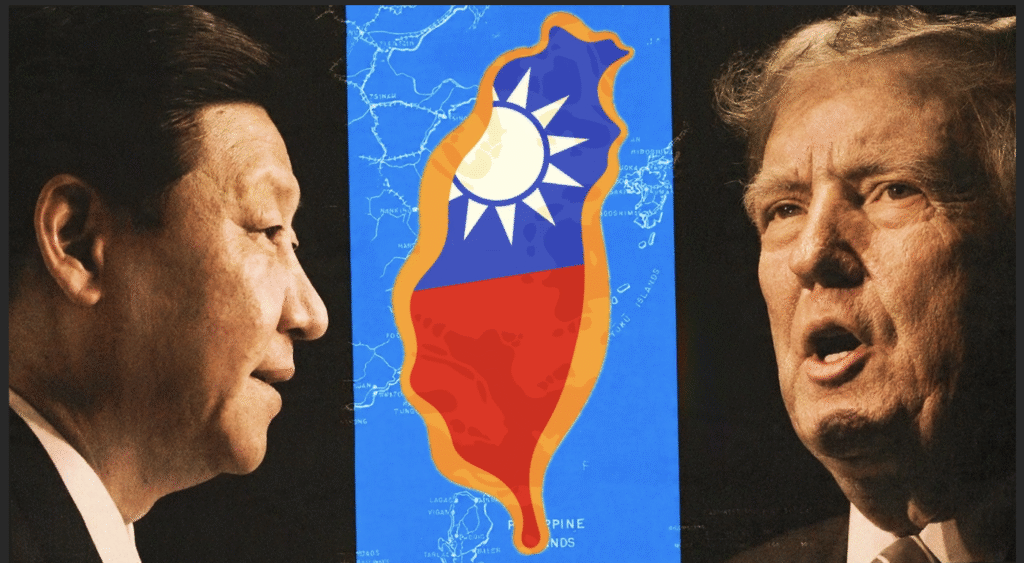
The Trump administration’s announcement on December 18, 2025, that it would give Taiwan an unprecedented $11.1 billion arms package is a key, although conflicting, milestone in U.S. foreign policy. The administration’s National Security Strategy (NSS) 2025 calls for ‘transactional isolationism,’ which means that Japan and South Korea, two of the US’s oldest allies, should take on more military and budgetary responsibilities. Still, this large amount of security package for Taiwan shows that the “First Island Chain” is being run in a different way.
The $11.1 billion defense package is the biggest single arms transfer to Taiwan in history, and it offers much more defense support than previous administrations did. The goal of the package is to improve Taiwan’s “asymmetric warfare” skills by moving the focus from high-tech weapons that look good to those that are portable, tough, and deadly. The package will have the following important parts:
• Precision Strike Systems: The release says that there are 82 High Mobility Artillery Rocket Systems (HIMARS) and 420 Army Tactical Missile Systems (ATACMS). These systems give Taiwan the potential to hit high-value targets across the Strait, making them a strong deterrent against amphibious staging grounds.
• Unmanned Aerial Systems (UAS): The Altius loitering munition drones, which are also called “suicide drones,” are getting more than $1 billion in funding. They want to stop invading naval forces by using synchronized swarming tactics. The package includes 60 self-propelled howitzer systems, over 1,000 Javelin anti-tank missiles, and TOW 2B missiles, which are focused on the last stage of defending the territory.
• Maritime and Electronic Support: The government is committed to improving digital capabilities on the battlefield, as seen by the refurbishment kits for Harpoon anti-ship missiles and the approximately $1 billion set aside for military software and electronic warfare systems.
Also Read: China Deploys ICBMs, Eyes Taiwan Invasion For 2027
The NSS 2025 and Global Burden Sharing Strategic Paradox: A lot of geopolitical critics are shocked by the statement because the National Security Strategy 2025 uses very clear language. The “Model Ally” idea in the NSS 2025 has put a lot of pressure on Tokyo and Seoul to spend more on their defenses. It often says it will take away U.S. security guarantees if countries don’t meet their goals for sharing the burden.
The plan says that partners ought to rely less on the U.S. ‘security umbrella’ and more on their own skills and capacities. But the way the administration treats Taiwan seems to go against this rule. The US wants Japan and South Korea to take the same position on Taiwan and strengthen its defense of the area.
This difference shows that the administration sees Taiwan as more than just an ally; it also sees it as a key “geographic linchpin” that separates Northeast and Southeast Asia. Because Taiwan’s semiconductor sector is so important to the country’s economy, the administration has named the island a “indispensable partner” in its economic security plan. This means that Taiwan doesn’t have to share the same heavy burden as treaty friends.
Taipei’s Response: independence and strength Taipei has said “thank you very much” and reaffirmed its national sovereignty. Karen Kuo, who speaks for President Lai Ching-te, said that the arms deal shows how strong the two countries’ “indestructible partnership” is. This goes along with President Lai’s proposal of an extra $40 billion for defense from 2026 to 2033.This shows that Taiwan is willing to work with the Trump administration by spending its own money on national security.
Taiwan’s leaders have said again that they don’t agree with what the People’s Republic of China (PRC) said. Taipei says that the Republic of China (Taiwan) is an independent country and that only its 23 million people can decide what happens next. Taiwan is clearly showing that it plans to take action against threats by getting long-range strike weapons like the ATACMS. Instead, it will strengthen its defenses so that any operation across the strait will be too expensive for the PRC.
Beijing’s Denunciation and the One China Policy: It’s not unexpected that Beijing has reacted with a lot of anger. A spokesperson for the Chinese Foreign Ministry, Guo Jaitun, said that the transaction was a “serious infringement” of the One China Policy and the three joint statements between China and the US. Beijing sees giving the island such modern weapons as a clear sign of support for “separatist factions.”
China says that Taiwan is an important part of its territory and has told the US that it is “inviting calamity upon itself.” Beijing sees the size of this $11.1 billion contract as a “red line,” which could mean that the People’s Liberation Army (PLA) needs to change its plans for “reunification.” The Chinese response makes it clear that no amount of foreign weapons can change the course of history toward unification.
Also Read: NATO: China May Use Russia To Distract Europe Over Taiwan
People think that what the U.S. is doing is interfering with China’s domestic affairs in a way that makes things less stable. The chance of conflict and instability in the region Putting a lot of military equipment in a very contested area makes it much more likely that there will be a full-scale war in Northeast Asia. The current path shows a “Security Dilemma,” in which Beijing sees any defensive move by Taipei and Washington as an aggressive threat. There are three main threats to the region’s stability:
1. The reason for a preemptive strike: Beijing may feel the need to attack Taiwan sooner, before Taiwan’s “porcupine strategy” is fully in place, as Taiwan gets more ATACMS and long-range drones.
2. Strategic Mistake: The U.S. strategy of putting pressure on Japan and South Korea while giving Taiwan weapons doesn’t make sense. This might make Beijing think that the U.S. alliance is weak, which could lead to a military challenge to U.S. will.
3. The “Powder Keg” Effect: The Taiwan Strait is now more militarized than it has been since the 1950s. A small tactical encounter or an unintentional clash between naval warships might quickly grow into a high-intensity conflict involving numerous nuclear-armed states.
The Trump administration’s $11.1 billion arms deal with Taiwan is a key event that shows how complicated “America First” diplomacy is these days. According to the National Security Strategy 2025, the US should stop being the world’s enforcer and force its partners to become self-sufficient. But the government has decided that Taiwan is too important to be left to its own devices. The “selective engagement” policy has helped Taiwan survive in an uneven way, but it has also made the region more likely to experience systemic conflict. We shall find out in the next few years if this big investment stops the war it was meant to stop or makes it worse.