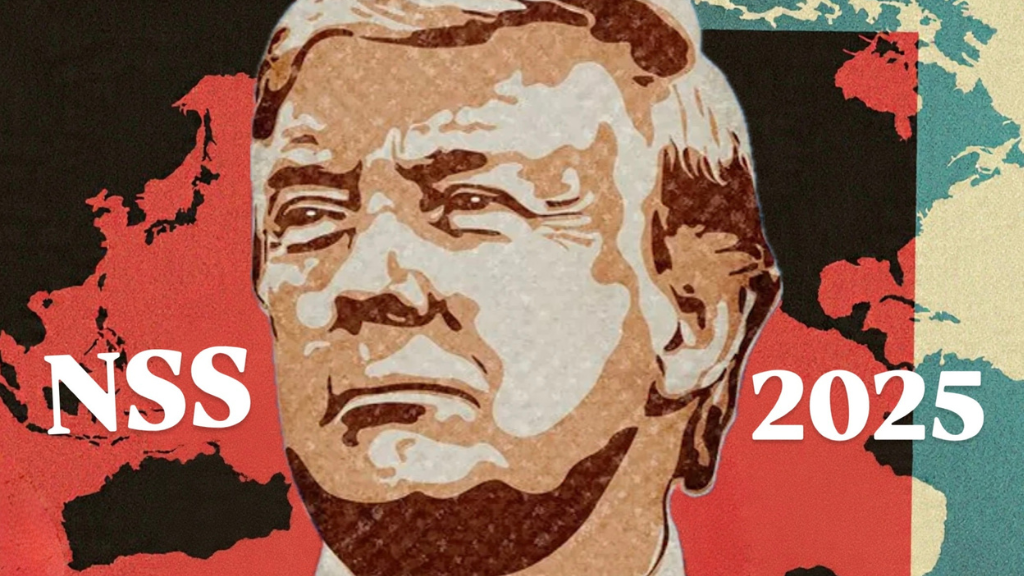
The 2025 National Security Strategy (NSS) released by the Trump Administration signifies a significant shift in U.S. foreign policy. It transitions from the “Great Power Competition” framework of 2017 to a neo-isolationist and exclusively transactional paradigm. The assertion undermines the credibility of U.S. extended deterrence by depicting the People’s Republic of China (PRC) chiefly as an economic rival instead of a strategic revisionist threat, while imposing stringent burden-sharing obligations on current security assurances in the Indo-Pacific.
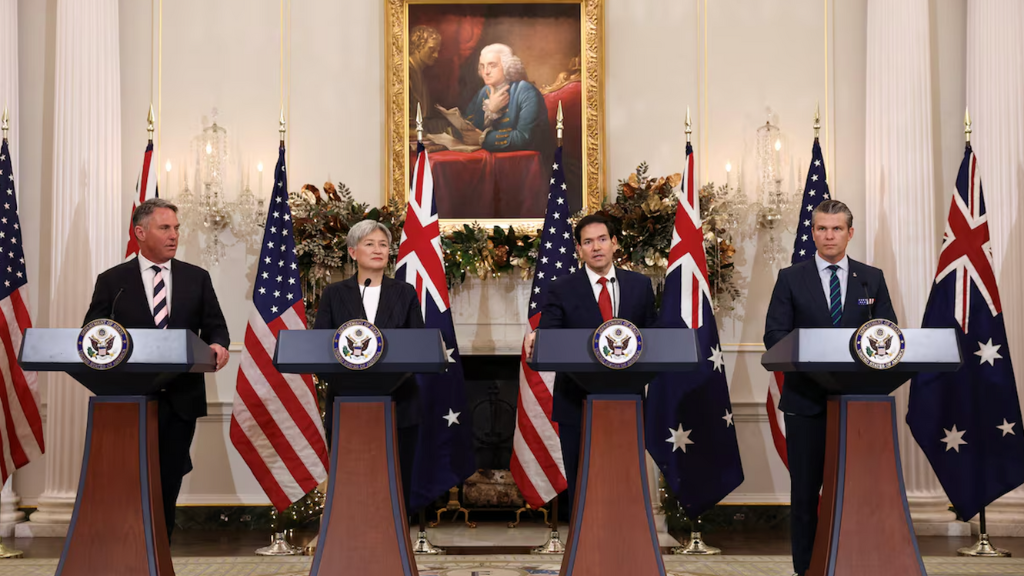
The U.S. administration’s dismissal of the QUAD (Quadrilateral Security Dialogue comprising Australia, India, Japan, and the U.S.A.) and its coercive actions against key allies specifically Japan, South Korea, and India generate a security dilemma that is likely to drive these nations towards strategic autonomy. This policy disengagement dismantled the security framework established post-World War II and may accelerate the proliferation of nuclear weapons in Northeast Asia, rather than enhancing stability via shared responsibility.
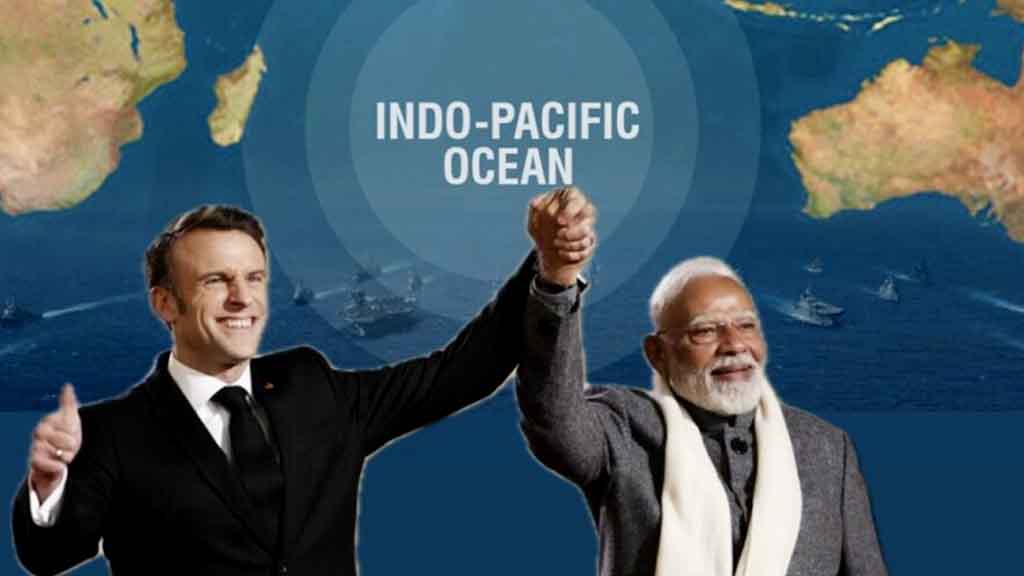
The 2025 NSS has redefined the dominance of the U.S. hegemony in its foreign relations. The previous U.S. administrations including both republicans and democrats always notably considered the Indo-Pacific region as the primary domain and platform for the global competitiveness despite being that the NSS 2025 ignores the Indo-Pacific region and implies it as a rise in “Indo-Pacific fatigue.”
Trump’s NSS 2025 dangerously ignores the Chinese threat and its military-strategic aspirations and transforms the U.S. alliance security into a trade deal and a commercial enterprise. These alterations may lead the “Quad” partners to feel excluded and cause allies such as South Korea and Japan to question the efficacy of the U.S. nuclear umbrella, which has served as the most effective non-proliferation instrument of the past century.
The Sinocentric Supervision Prioritizing Economics Over Geostrategy
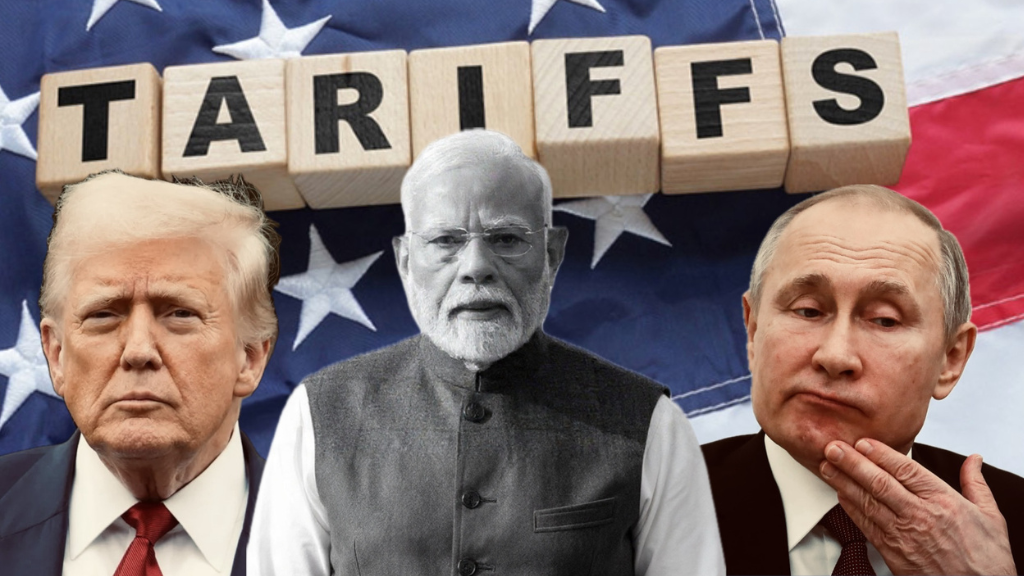
A significant deficiency in the 2025 NSS is its oversimplification of China. The NSS 2025 perceives Beijing solely as a trade adversary, a rival that can be managed by tariffs and other agreements. This fails to consider all the ways in which China poses a threat. The U.S. intelligence community disapproves of this plan. They believed that China’s rapid enhancement of its naval and nuclear arsenal were strategies to augment its dominance and displace the U.S. from the Western Pacific, rather than methods of negotiation.
The concept of “economic peace” possesses a strategic deficiency. If Washington perceives its conflict with Beijing as merely a commercial transaction, it implies that Taiwan or the South China Sea are negotiable assets in a broader trade agreement. This concept is concerning for allies in the Indo-Pacific region. It proposes a return to a sphere-of-influence model wherein trade imbalances supersede security obligations. The NSS 2025 somehow indirectly permits China to engage in limited expansionism provided it purchases sufficient American agricultural products. This is due to its failure to perceive China as a revisionist entity seeking to alter international norms.
The Ramifications of Estranging India is Disbanding the QUAD: The primary strategic ignorance of the NSS 2025 appears to be the underestimation of the Quad’s significance. To equilibrate China’s demographic and maritime strength, the coalition of the U.S., Japan, Australia, and India need substantial engagement from New Delhi. The NSS’s emphasis on stringent alignment and financial incentives jeopardizes India’s enduring commitment to “strategic autonomy.”
It is a political error to assume that India, a nation with a complex defense relationship with Russia, will fulfill the requirements of the U.S. security budget. India perceives the Quad as a mechanism for the four nations to collaborate in ensuring maritime security, rather than as a means for one nation to dominate another.
If New Delhi perceives the U.S. as an unreliable offshore balancer that regards allies as mere clients, it is likely to revert to a non-aligned stance or seek rapprochement with Beijing. The Quad would essentially disintegrate if India withdrew. This would eliminate the southern segment of the Indo-Pacific containment strategy, granting the People’s Liberation Army Navy (PLAN) unrestricted access to the Indian Ocean Region (IOR).
The Diminution of Extended Deterrence and Its Nuclear Consequences
The NSS 2025 presents the most significant risk owing to the implicit threat of withdrawing security assurances from Japan and South Korea if they fail to fulfill unrealistic burden-sharing demands. This transactionalism fundamentally misconstrues the concept of “extended deterrence.” Deterrence relies on credibility, indicating that the U.S. will assuredly engage. By conditioning participation on annual payments, the government transforms a contractual obligation into a protective framework. Seoul and Tokyo must confront a disheartening reality: they can no longer rely on Washington for their security due to prevailing uncertainties. This document serves as a catalyst in South Korea, where majority of the population currently endorses the development of nuclear weapons within the nation. If individuals believe that the U.S. nuclear umbrella is inadequate or excessively costly, Seoul ought to develop its own nuclear deterrent to safeguard itself against North Korea.
Japan, historically the most “nuclear-allergic” nation, must now confront a comparable decision. Tokyo may perceive its pacifist constitution as a perilous arrangement due to its proximity to China, Russia, and North Korea, all of which possess nuclear arsenals, and its reliance on U.S. security is uncertain. The result would be the proliferation of nuclear weapons across Northeast Asia, undermining the global non-proliferation regime and destabilizing the nuclear equilibrium in the region, complicating U.S. oversight.
The Specter of Strategic Autonomy The 2025 National Security Strategy is predicated on the erroneous assumption that allies possess no alternative options. It assumes that the U.S. may impose the highest price for its security assurances without diminishing the product’s worth. This constitutes an error. The immediate advantage of reducing U.S. defense expenditure will be benefited by China.
The administration is undermining “America First” by betraying the trust of India, Japan, South Korea, and Australia. Rather, it is establishing a “Post-American” Indo-Pacific. Allies will not remain passive clients; they will evolve into autonomous military forces. These nations will prioritize their strategic autonomy as trust diminishes.
They will enhance their capacity to project power and potentially develop their own nuclear arsenal. The United States will not resolve its issues through this approach; rather, it will become increasingly estranged from the region that will define the 21st century.