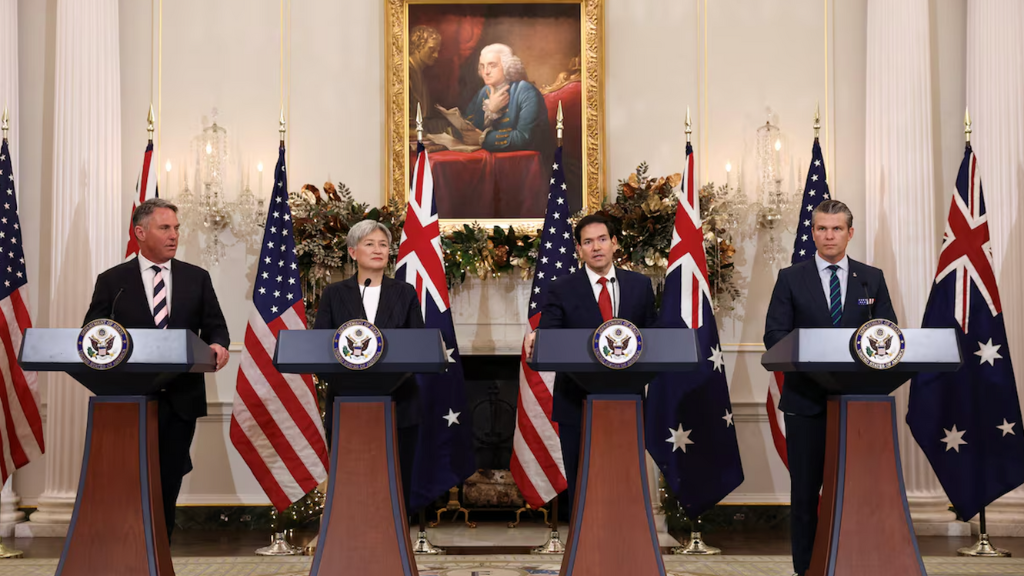
On December 10, 2025, the defense ministers of Australia, the UK, and the US met at the Pentagon to reaffirm an alliance that has profoundly changed the strategic structure of the Indo-Pacific. The meeting between Australian Deputy Prime Minister Richard Marles, UK Defense Secretary John Healey, and US Secretary of War Pete Hegseth was more than a diplomatic formality; it was a signal of operational urgency.
Facing a security environment described as the most dangerous since the Second World War, the ministers declared their intent to move “full steam ahead” with the AUKUS pact. This meeting made it clear to Australia that they were moving from planning in theory to the hard work of mobilizing industry. Canberra is now investing in the US submarine industry, a first for the alliance, in addition to buying defense weapons.
The Mechanism: Australia’s Heavy Lift
The primary outcome of the December 2025 meeting was that the “Optimal Pathway” for Australia to get nuclear-powered assault submarines (SSNs) became a reality. This path is a long, complicated logistical race that will fill in the gaps in Australia’s aging Collins-class fleet.
Australia’s Responsibilities have Evolved into a Three-Part Industrial Mandate:
1. Financial investment into US industries: Australia’s direct sponsorship of US shipyards is a key and contentious part of the plan. After the meeting, it was confirmed that Canberra would send the next part of a multi-billion-dollar investment to US facilities, such Electric Boat in Connecticut, to increase their production capacity. This situation leads to a strange “sovereignty paradox” in which a foreign power’s ability to make things depends on Australian tax money.
2. Infrastructure Development: Australia is responsible for turning the Osborne Naval Shipyard in South Australia into a place where the SSN-AUKUS may be built. This ship is a mix of British and American designs. This undertaking needs more than just concrete and steel; it needs thousands of skilled workers, which means a massive domestic upskilling program.
3. Nuclear Stewardship: Perhaps the heaviest burden is the regulatory and safety framework. In order to satisfy both the International Atomic Energy Agency (IAEA) and its AUKUS allies, Australia must show that it is “responsible nuclear stewardship.” Finding long-term strategies to dispose of nuclear waste is a politically charged challenge that we have only partially addressed.
Strategic Necessity: The Oppression of Distance
Why did Australia agree to a program that might cost as much as AUD 368 billion? The explanation is in how the Indo-Pacific’s geopolitics is evolving. The strategic rationale for nuclear propulsion compared to traditional diesel-electric vessels is exclusively kinematic. A regular submarine has to snorkel often to charge its batteries, which makes it easier for radar and satellite monitoring to locate it. An SSN, on the other hand, has almost no limits on its range and endurance, except for food and crew morale.
Australia is an island continent that relies on shipping routes that go through the contentious South China Sea. The capacity to stay undetected for months is seen as the only viable deterrent. The Royal Australian Navy can project strength far beyond the “sea-air gap” to Australia’s north with the SSNs. This could conceivably threaten an enemy’s naval assets at their source. This changes Australia’s defense strategy from “continental defense” (defend the coastline) to “forward defense” (deterrence by denial in the open ocean).
The China Factor: Deterrence or Provocation?
The People’s Republic of China is the unspoken (and often voiced) reason behind AUKUS. There was more tension in the Taiwan Strait and the South China Sea before the conference in 2025.
Canberra believes that AUKUS is an essential balance. Australia asserts the need for a credible deterrent to prevent any single power from hegemonically dominating the Indo-Pacific trade lifelines. This is because China’s navy modernization is making the world’s largest fleet. The logic is one of “peace through strength”—that war is less likely if the cost of aggression is prohibitively high.
But Beijing sees AUKUS as a way to completely encircle it. The Chinese Ministry of National Defense consistently declared the deal a “path of error and danger,” saying that the three countries are making the nuclear weapons race worse. The “security dilemma” is the main source of tension. Australia’s efforts to enhance its security by acquiring SSNs make China feel threatened, which in turn prompts China to increase its own military capabilities, thereby reinforcing Australia’s initial concerns.
The fight is not just military; it is also diplomatic. China has used the AUKUS deal to call out Australia for being hypocritical about nuclear proliferation in the Global South and Pacific Island nations. This makes it harder for Canberra to accomplish diplomacy in the region. The 2025 meeting’s reaffirmation of the accord certainly means that high-level strategic trust between Canberra and Beijing will stay frozen for a long time, even though bilateral trade relations between Australia and China are nevertheless working.
The Sovereignty Debate
A critical evaluation of the recent meeting must consider the issue of sovereignty. Critics say that by making its submarine force so dependent on US technology and logistics, Australia has sacrificed its strategic sovereignty.
If the SSN-AUKUS depends on US combat systems and UK design specifics, can Australia really run these ships on its own? Or does the “interchangeability” celebrated by the defense ministers imply that the Royal Australian Navy will become a de facto extension of the US Navy’s Pacific Fleet? The promise of “seamless” integration by 2025 means that the latter is a feature of the system, not something amiss. The government states that capability equates to sovereignty, implying that Australia lacks options in a conflict without a superior choice of instrument.
The AUKUS Defense Ministers’ Meeting of December 2025 marked the point of no return for Australia. The government has tied its long-term plans to the strength of American factories and British design. Nuclear propulsion could be deemed necessary by AUKUS for strategic reasons because of the rough topography of the Pacific and the fact that China’s navy is growing, yet the risks are profound. Australia is putting its defense budget, diplomatic capital, and strategic autonomy on the line for a complicated, multi-decade undertaking that will need to be done perfectly by three successive governments. As the world order breaks down, AUKUS represents a risk; in the perilous waters of the 21st century, it is safer to swim with the giant whales than to float alone.
Dr. Niraj Kumar Das holds a PhD from Jawaharlal Nehru University. His expertise lies in nuclear governance and strategic competition involving nuclear technologies. His research interests focus on the intersection of International Relations, Nuclear Diplomacy, and Security Studies, with a specialization in U.S.–North Korea nuclear diplomacy, East Asian security, and geopolitics.