Poland’s Quiet Entry Into the Global Economic Elite
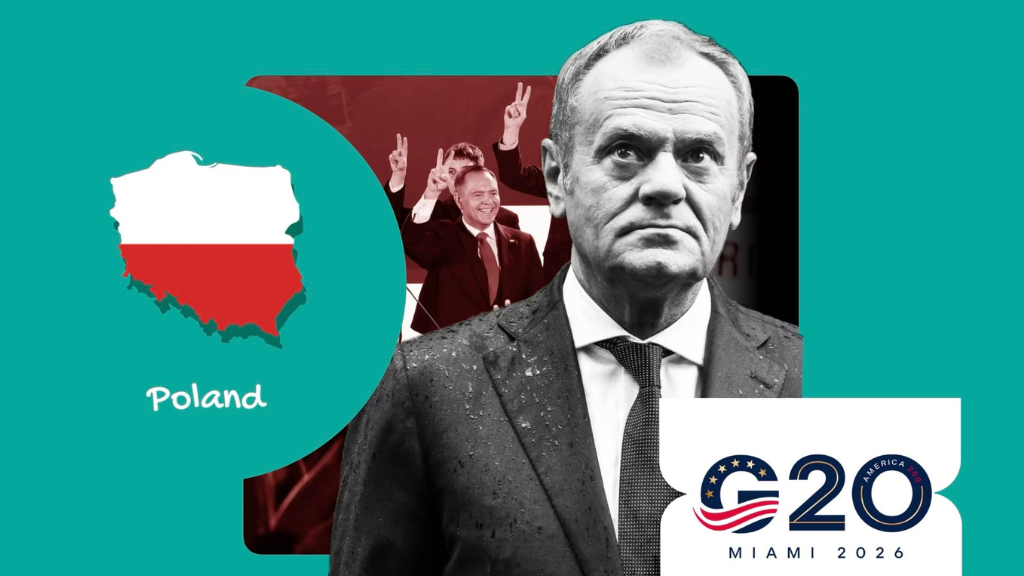
Poland’s rise has been gradual, not dramatic. Yet that steady climb has brought the country within reach of one of the world’s most exclusive economic circles. After crossing the $1 trillion GDP mark and receiving an invitation to observe the 2026 G20 summit in Miami, Warsaw now stands on the threshold of a global breakthrough. Only a generation ago, such recognition would have seemed implausible.
This moment reflects more than economic success. It signals Poland’s arrival as a serious geopolitical and economic actor.
From Post-Communist Transition to Sustained Growth
Few European states have transformed as consistently as Poland. Over just two decades, it moved from post-communist uncertainty to become one of the European Union’s fastest-growing economies. Strong domestic demand fueled expansion. EU structural funds modernized infrastructure. A competitive manufacturing and services base anchored long-term growth.
In September, the International Monetary Fund confirmed that Poland’s nominal GDP had exceeded $1 trillion. That figure places Poland among the world’s top 20 economies. It now ranks ahead of Switzerland and aligns with mid-sized Western European powers.
The milestone mattered on its own. What followed carried even greater strategic weight.
A G20 Disruption Creates an Unexpected Opening
Until now, the G20 had never invited a Central or Eastern European country to its leaders’ table, not even as an observer. That precedent shifted after controversy surrounded the 2025 summit in Johannesburg.
U.S. President Donald Trump accused South Africa of persecuting its white minority and boycotted the meeting. He later withdrew South Africa’s invitation to host the 2026 summit in Miami. The decision marked the first time the G20 sidelined a host country.
Washington moved quickly. It backed Poland as the replacement observer. U.S. Secretary of State Marco Rubio urged Poland to “assume its rightful place in the G20,” framing the invitation as recognition of Warsaw’s economic achievements and post-Cold War resilience.
For Poland, the symbolism runs deep. In 1989, it remained bound to the Soviet-dominated Warsaw Pact. Thirty-six years later, it will sit at the G20 table.
Why Poland Fits the G20’s Evolving Profile
The G20 does not rely on economic metrics alone. Politics and precedent still shape membership. Even so, Poland presents a compelling case.
It is the largest economy in Central and Eastern Europe. Its economic weight has long exceeded the region’s limited representation through the EU’s collective seat. Analysts argue that the South Africa controversy merely accelerated a process already underway.
Marcin Klucznik of the Polish Economic Institute describes Poland’s trajectory as “a harbinger of Central Europe’s success.” A country once viewed as peripheral now functions as a stabilizing growth engine. Its development path offers lessons that emerging economies can realistically apply.
Entering the G20 Amid Institutional Uncertainty
Poland steps into the G20 conversation at a moment of uncertainty for the group itself. The G20 lacks formal institutional structure, and internal divisions have deepened. Members clash over Russia’s war in Ukraine, global trade rules, climate finance, and technology standards.
At the same time, new geopolitical blocs challenge the group’s relevance. BRICS has expanded rapidly and now positions itself as an alternative to Western-led institutions. Its members promote local-currency trade and question U.S. financial dominance.
Meanwhile, renewed tariff threats and growing protectionism have weakened the G20’s original mission of defending open markets.
Against this backdrop, analysts see Poland offering two assets the forum increasingly lacks: a consistent pro-trade stance and a security perspective shaped by proximity to Russia.
A Security Perspective Rooted in Geography
Poland’s strategic outlook reflects its historical experience with Moscow. That experience shapes how it links economic stability to national security.
“Central and Eastern European countries have a sharper understanding of the risks posed by Russian aggression,” Klucznik argues. He views that perspective as essential for any forum debating global economic resilience.
As the war in Ukraine approaches its fourth year, divisions inside the G20 have repeatedly blocked unified responses. Poland’s presence, even as an observer, introduces a regional voice that treats sovereignty, defense, and economic resilience as interconnected concerns.
A Development Model With Broader Relevance
Poland’s rise carries significance beyond geopolitics. Its economic transformation offers a practical model for emerging economies. EU funding supported reform. Industrial competitiveness attracted capital. Political stability reinforced investor confidence.
Dalibor Rohac of the American Enterprise Institute calls this outcome deliberate rather than accidental. He argues that Poland now occupies a credible position between advanced and developing economies.
The G20’s mandate includes debt relief, climate adaptation, and financial inclusion. Poland’s journey from underdevelopment to full integration adds practical insight to those debates.
The Long Path Toward Permanent Membership
U.S. backing remains strong, and Polish officials describe the Miami invitation as the start of a gradual accession process. Still, permanent membership remains uncertain.
Several current G20 members, including Argentina, South Africa, and Saudi Arabia, remain in the group despite falling outside the world’s top 20 economies. Their presence reflects political legacy rather than current economic rank.
Competition also intensifies. Nigeria, Vietnam, and other fast-growing economies continue to press for inclusion.
Some analysts expect Poland’s bid to take a decade or longer. Others argue that U.S. support, combined with Poland’s trillion-dollar economy, may force the G20 to reconsider its framework sooner.
A Long-Awaited Moment of Global Recognition
Even without a permanent seat, Poland’s observer status marks a turning point. It signals recognition not only of Poland’s transformation but also of Central Europe’s growing relevance.
In Miami, Warsaw will arrive with a trillion-dollar economy, strong transatlantic ties, and a development story that resonates with emerging markets. Whether this moment leads to lasting influence or fades with shifting geopolitics remains uncertain.
For now, Poland has achieved something it long sought: visibility at the highest level of global economic diplomacy.