Sudan’s descent into open warfare in April 2023 did not erupt from a vacuum. The country had been staggering under the weight of decades of authoritarianism, economic collapse and militarised politics long before the first gunshot echoed across Khartoum.
Omar al-Bashir’s 30-year rule left behind sprawling security networks, overlapping paramilitary structures and a political culture where armed groups often eclipsed civilian authority. After his fall in 2019, a fragile transitional arrangement offered a brief window for rebuilding, but it was quickly consumed by old rivalries.
At the centre of those tensions stood the Sudanese Armed Forces (SAF) and the Rapid Support Forces (RSF) – the latter descended directly from the Janjaweed militia implicated in mass atrocities in Darfur during the 2000s. When the transitional government faltered and negotiations collapsed, the uneasy balance between these two power centres slipped into open confrontation.
By mid-2023, Sudan had fractured into contested zones, major cities turned into frontlines, and millions of civilians were displaced in one of the world’s fastest-growing humanitarian catastrophes.
Europe’s Distance Did Not Mean Innocence
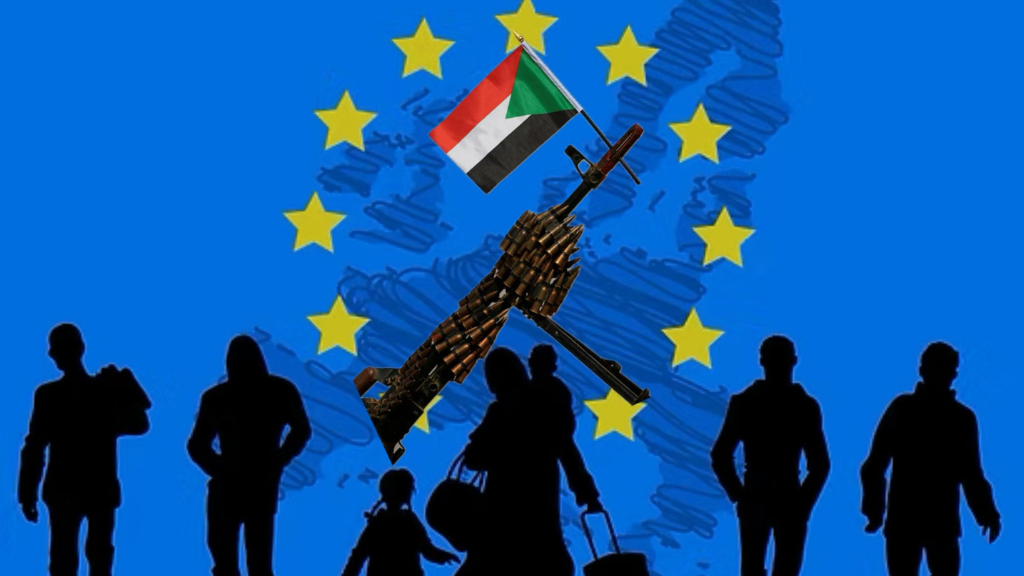
Although thousands of kilometres away, Europe was not a bystander. For nearly a decade, the European Union pursued a strategy of outsourcing migration control to African states. Through the EU Emergency Trust Fund for Africa (EUTF) and the Better Migration Management (BMM) programme, Brussels channelled over €200 million into Sudan between 2014 and 2018. The stated goal was simple: curb irregular migration before it reached Europe’s shores.
In practice, this strategy embedded the EU directly into Sudan’s coercive institutions. The money funded border management, surveillance equipment and training programmes, ostensibly to counter human trafficking. In a country where state agencies were deeply entangled with armed paramilitary groups, these initiatives inevitably strengthened the very forces that would later plunge Sudan into war.
Warnings came early. In 2017, the Enough Project bluntly described EU-Sudan cooperation as “border control from hell,” arguing that the RSF – already notorious for abuses – stood to benefit materially and politically. Their report warned that equipment designed to identify migrants would just as easily expand the state’s surveillance arsenal against civilians.
Two years later, the EU quietly suspended some activities in Sudan after acknowledging that resources risked being “diverted for repressive aims.” Yet official EU statements continued to deny that the RSF benefited “directly or indirectly” from European support. The contradiction between warnings and policy persisted, raising a troubling question: if diversion was recognised as a risk, why did funding continue in a context where oversight was almost impossible?
Arms Embargoes Breached Through the Back Door
Europe’s role was not confined to migration funding. Its weapons – manufactured legally and exported legally – began surfacing on Sudan’s battlefields. None were sold directly to Sudan due to longstanding embargoes. Instead, they reached the RSF and SAF through third countries, most notably the United Arab Emirates, which has frequently been cited as a hub for re-exporting military equipment.
Amnesty International’s 2024 investigation uncovered Nimr Ajban armoured vehicles fitted with French-made Galix defensive systems in Sudanese conflict zones, including areas covered by the UN arms embargo.
France 24 and Reuters traced 81mm mortar shells found in an RSF convoy back to a Bulgarian manufacturer; the ammunition had been exported to the UAE in 2019 and then diverted without Bulgarian approval. The Guardian later reported that British-made equipment, including engines for armoured vehicles, had also reached RSF units, again apparently via the Emirates.
The UAE denies facilitating any transfers to Sudan’s warring factions. Yet the pattern is unmistakable: weapons built in Europe, exported legally to trusted partners, repeatedly resurfaced in embargoed conflict zones. Under EU and UK export regulations, licences should be revoked when there is a clear risk of diversion. Nevertheless, governments continued approving new sales.
Middle East Eye’s reporting revealed that the UK alone authorised around $227 million in military exports to the UAE between April and June this year, despite being informed that Emirati-supplied equipment had already reached Sudan.
A Global Problem, Not a Regional Exception
Europe is not the only actor implicated in weak end-user controls. South Africa has grappled with similar failures. During the Yemen war, South African-made weapons appeared in Saudi and Emirati arsenals under circumstances that raised concerns about unauthorised diversion.
The National Conventional Arms Control Committee responded by delaying approvals and insisting on on-site inspections, but several importer states refused access. Eventually, after years of contention, many of the blocked consignments were cleared under renegotiated terms – though questions about diversion never fully dissipated.
Now, investigators believe some South African-manufactured munitions may have surfaced in Sudan as well. The South African example underscores how challenging enforcement can be, even when there is political will to comply with international norms.
A Policy That Promised Security but Helped Erode It
Europe’s migration agenda was designed to stem irregular movement and stabilise partner countries. Instead, it sharpened authoritarian tools, empowered abusive security actors and indirectly fed the conflict economy.
The arms diversion problem deepened these contradictions: policies framed as protecting Europeans from insecurity ended up fuelling insecurity elsewhere.
If democratic governments hope to restore credibility, oversight mechanisms must become more than paperwork. End-use monitoring must be rigorous, transparent and enforceable. Export authorities in Brussels, Paris, Sofia and London should audit past licences, investigate confirmed diversion cases and halt new approvals until safeguards are proven effective. Migration funding, likewise, requires firewalls to ensure it cannot be captured by armed actors.
Sudan’s war is the product of internal rivalries and historical wounds, but the international system around it — aid frameworks, export policies, and geopolitical alliances — helped shape the battlefield. Europe’s intentions may have been framed in humanitarian or security terms, but without accountability and oversight, those same policies contributed to entrenching the warlords now tearing Sudan apart.